


Book An
Appointment
Lorem ipsum dolor sit amet, consectetur adipiscing elit, sed do eiusmod tempor incididunt ut labore et
Our Services
Table of Contents
- Why Commercial Plumbing Maintenance Matters for Small Businesses
- What Commercial Plumbing Maintenance Includes
- Your Commercial Plumbing Maintenance Checklist
- Building a Commercial Plumbing Maintenance Schedule That Fits Your Business
- Preventive Plumbing Maintenance for Businesses: Backflow, Pipes, and Sewer Lines
- Commercial Plumbing Repair Costs and Repair-vs-Replace Decisions
- How to Choose a Commercial Plumbing Maintenance Provider
- Compliance, Records, and Business Continuity
- Frequently Asked Questions
Last Updated: October 5, 2026
Why Commercial Plumbing Maintenance Matters for Small Businesses
Commercial plumbing maintenance for small businesses means scheduling routine inspections, cleaning, and repairs across a building’s water supply, drains, fixtures, and water heating equipment before small faults become expensive failures. At CW Plumbing, we see the same pattern repeatedly: a business owner calls us for an emergency a routine inspection would have caught months earlier. A failing shutoff valve, a slow drain, or a corroded fitting rarely announces itself, it waits until a Friday afternoon rush, then floods a stockroom.
The real cost of putting off plumbing maintenance
The expense of a plumbing failure is never just the repair bill. A burst pipe can shut down a kitchen, force a retail closure, or send water into inventory and electrical systems.
Many small operators treat plumbing like a car’s check-engine light: ignore it until it becomes undrivable. A maintenance schedule flips that logic, spend a modest amount now to avoid a large, disruptive bill later.
The most common mistake we see is waiting for a visible symptom. By the time water pools on the floor or a drain backs up, the underlying damage has usually been developing for weeks. A slow drain or a faint drip is your warning, not your inconvenience.
What Commercial Plumbing Maintenance Includes
A commercial maintenance visit covers the systems that carry water into, through, and out of your building. Scope depends on your facility, but most programs address water pressure and flow, leak detection, drain and sewer lines, and water heating equipment, finding and fixing small issues before they interrupt operations.
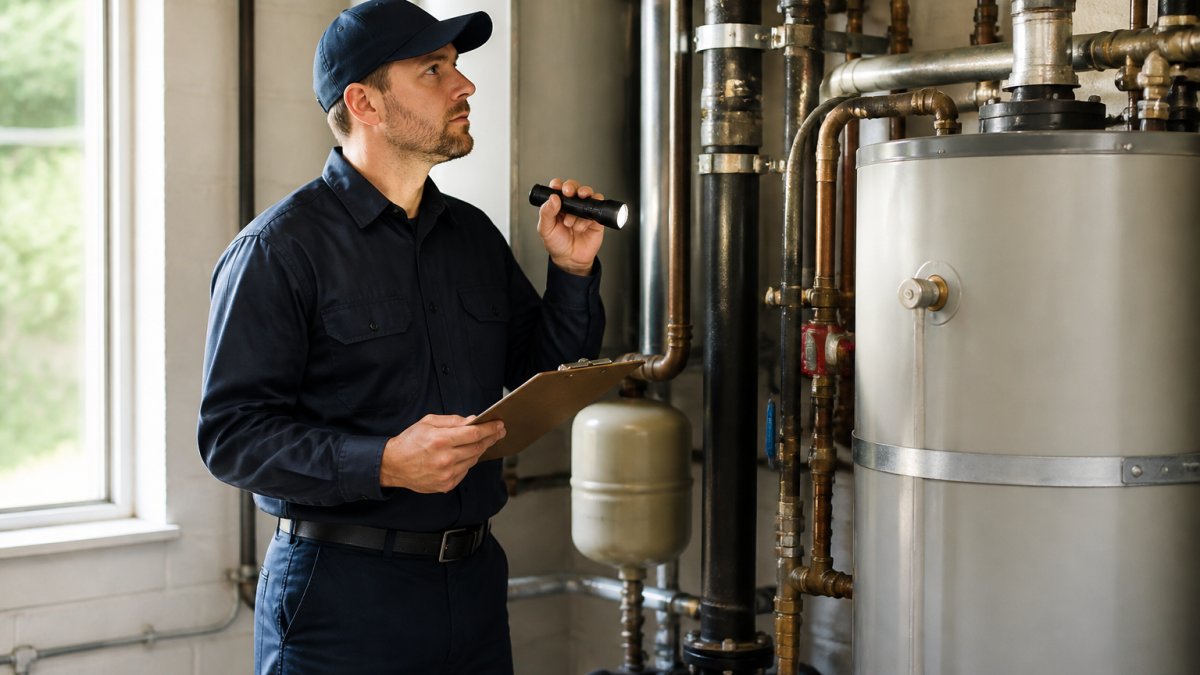
Routine plumbing inspections
A routine inspection is a scheduled walkthrough to check for wear, corrosion, leaks, and code issues before they escalate. Inspectors check visible pipes, joints, shutoff valves, supply lines, fixtures, and the water heater, test water pressure, look for hidden moisture, and confirm safety devices like backflow assemblies are functioning.
Leak detection, drain cleaning, and water heater service
Leak detection uses pressure testing and, where needed, camera equipment to locate hidden leaks in walls, slabs, or underground lines. Drain cleaning removes grease, scale, and debris before lines clog. Water heater service flushes sediment, checks the anode rod, and verifies temperature and pressure relief valves.
For stubborn commercial clogs, hydro jetting uses high-pressure water to scour the full diameter of the pipe rather than punching a hole through the blockage.
Ask whether your provider uses a sewer camera before recommending a major repair. Camera inspection lets you see the actual condition of the line, including root intrusion or cracks, before you commit to excavation or replacement.
Your Commercial Plumbing Maintenance Checklist
A commercial plumbing maintenance checklist keeps inspections consistent so nothing gets skipped between visits. Adjust this starting point to your building.
- Test water pressure at multiple fixtures and note any drop
- Inspect all visible supply lines and joints for corrosion or moisture
- Check shutoff valves under sinks and at main lines for smooth operation
That log becomes your history, letting you compare a recommended repair against prior visits instead of taking it on faith.
Building a Commercial Plumbing Maintenance Schedule That Fits Your Business
A commercial plumbing maintenance schedule should match how hard your plumbing works, not a generic calendar. A restaurant with heavy grease loads needs different attention than a light-use office. Start with your highest-risk systems and build outward.
Tailoring the schedule to your business type and building size
Match frequency to usage and risk. Here is how we would think about it:
| Business Type | Inspection Frequency | Priority Systems |
|---|---|---|
| Restaurant or food service | Monthly to quarterly | Drain lines, grease traps, water heaters |
| Retail or office | Quarterly to twice yearly | Fixtures, supply lines, restrooms |
| Multi-tenant or mixed use | Quarterly | Sewer lines, backflow, water pressure |
| Warehouse or light industrial | Twice yearly | Main lines, sump pumps, backflow |
Building size changes the plan too. A single-suite retail space may need one annual inspection and a water heater check; a multi-story building with shared restrooms, a commercial kitchen, and a boiler room needs quarterly visits and a documented backflow testing schedule. The more fixtures, users, and grease or waste your building produces, the shorter the interval between inspections.
Your schedule is not a fixed rule. Review it after the first year. If inspections keep finding the same issue, shorten the interval for that system. If a system stays clean for three visits, you can stretch it.
Preventive Plumbing Maintenance for Businesses: Backflow, Pipes, and Sewer Lines
Preventive plumbing maintenance for businesses targets the systems most likely to cause a shutdown: backflow assemblies, pipe networks, and sewer lines, where a small failure has the largest consequence.
Backflow prevention stops contaminated water from reversing into your clean supply. Many commercial properties must have backflow assemblies tested on a set schedule, with results documented.
Pipes and sewer lines age, corrode, and collect buildup.
Commercial Plumbing Repair Costs and Repair-vs-Replace Decisions
Commercial plumbing repair costs vary widely based on the system, access, and parts involved, so we do not quote numbers without seeing the job. What we can offer is a decision framework, which matters more than a ballpark figure anyway.
Ask three questions before approving a repair:
- Age. Is the component near or past its expected service life? If so, repeated repairs are money into a dying asset.
- Frequency. Has this same part failed more than once in a short period? Repeat failures point to a deeper cause.
- Consequence. What happens if it fails again during business hours? If the answer is “we close,” replacement usually wins.
A cheap repair on a failing water heater or crumbling sewer line is a delay, not a fix. Planned replacement lets you control the timing and cost instead of reacting to a failure.
What actually drives the price of a commercial plumbing repair
Most providers price a job from the same handful of variables. Knowing them lets you sanity-check any quote.
- Access. A fixture that is out in the open takes minutes to reach. A line buried under a slab, behind finished drywall, or under a commercial kitchen floor takes hours of demolition and restoration. Access is usually the single largest swing factor in a quote.
- Time of day. After-hours, weekend, and holiday emergency calls carry premium labor rates. A scheduled weekday visit does not.
- Diagnostics required. Camera inspection, hydro jetting, and pressure testing add cost, but they also prevent you from paying for the wrong repair.
Ask the provider to break a quote down along these lines. A quote separating labor, parts, access, and diagnostics is easier to compare against a second bid than a lump sum.
How to budget for plumbing maintenance
Treat maintenance as a line item, not a surprise. Set aside a fixed annual amount for scheduled service and hold a separate reserve for repairs and replacements, reviewing both after each inspection cycle.
To size that reserve, think in terms of expected service life. Water heaters, backflow assemblies, and drain lines each have a predictable replacement window, shorter in high-use buildings.
A repair is the right call when the component is young, the failure is isolated, and access is easy. Replacement wins when the component is old, the failure is recurring, or a second failure would shut you down. When in doubt, ask what the total cost of ownership looks like over the next three years, not just today.
How to Choose a Commercial Plumbing Maintenance Provider
Choosing a provider comes down to licensing, equipment, communication, and records. Ask directly and expect clear answers.
- Licensing and insurance. Confirm the provider is licensed and insured before any work begins.
- Diagnostic equipment. Ask whether they use sewer cameras and hydro jetting, or only basic snaking.
- Documentation. A good provider gives you written findings, photos, and a maintenance history you keep.
Small businesses and property managers who want a documented maintenance history and a provider that shows up for both scheduled service and emergencies.
A provider who explains what they found and why it matters is worth more than one who simply hands you a bill. If a technician cannot say what they inspected and its condition, you are paying for a visit, not maintenance.
A vendor-selection framework you can actually use
Most small businesses pick a plumber the way they pick a dentist: whoever answers the phone first.
1. Verify credentials before you need them. Ask for the license number and a certificate of insurance, and confirm both are current.
**2.
**3.
**4.
**5.
6. Check references from businesses your size. A provider who maintains large industrial facilities may not prioritize a single-suite retail space.
Red flags to watch for
- A quote with no breakdown of labor, parts, and access.
- A recommendation for major excavation or replacement without a camera inspection first.
- No written findings after a visit.
Run the same five questions past two or three providers and compare the answers side by side. The differences in response time, documentation, and equipment will usually make the decision obvious, and the comparison gives you leverage on price.
Compliance, Records, and Business Continuity
Compliance and continuity are the quiet payoff of a maintenance program. Keep backflow test records, inspection logs, and repair history in one place, so when a code inspector, insurer, or landlord asks for proof of maintenance, you have it.
Business continuity is the other half. A plumbing failure during operating hours costs customers, staff time, and revenue.
Plumbing problems rarely pick a convenient moment, and for a small business, an untimely failure can cost far more than the repair itself. CW Plumbing is a family and locally owned team serving commercial and residential clients, with the diagnostic equipment and experience to catch issues early and fix them right.
Frequently Asked Questions
What does commercial plumbing maintenance include?
Commercial plumbing maintenance covers routine inspections of the entire plumbing system, leak detection and repair, drain cleaning and clog prevention, water heater service, backflow prevention and testing, and checks on fixtures, faucets, toilets, pumps, and sump pumps. It also includes pipe inspection and repair for water supply and sewer lines. The goal is to catch small issues like slow drains or minor leaks before they disrupt your business or turn into costly repairs.
How often should a small business schedule plumbing maintenance?
Most small businesses benefit from professional preventive plumbing maintenance at least twice a year, with quarterly inspections for high-traffic restrooms, commercial kitchens, or buildings with older pipe systems. A commercial plumbing maintenance schedule should also include monthly in-house checks of visible fixtures and drains. Restaurants, clinics, and retail spaces with heavy daily water use often need more frequent service than low-traffic offices.
How much does a commercial plumber charge?
Commercial plumbing repair costs depend on the scope of work, the age and layout of your building, and whether the job requires specialty equipment like hydro jetting or sewer camera inspection. Emergency plumbing calls typically cost more than scheduled maintenance. Because pricing varies so much by job, ask your provider for a written estimate before work begins and consider a service plan that bundles routine inspections at a predictable rate.
What should a commercial plumbing maintenance checklist include?
A useful checklist covers routine inspection of fixtures, faucets, and toilets for leaks or running water; drain lines and sewer lines for slow drainage; water pressure and water flow at key points; water heater service and temperature settings; backflow testing; sump pump and pump operation; and pipe inspection for corrosion or moisture. Add a monthly in-house walkthrough to spot leaks, water waste, or odd noises early between professional visits.
How can a small business prevent clogged drains and sewer backups?
Clog prevention starts with rules for what goes down drains, especially in kitchens where grease and food waste cause most blockages. Schedule regular drain cleaning and hydro jetting to clear buildup in drain lines before it blocks flow, and ask for a sewer camera inspection if you have older pipes or tree roots nearby. Addressing slow drains immediately prevents emergency plumbing calls and sewage backups during business hours.
When should a business call an emergency commercial plumber?
Call for emergency plumbing service when you have a burst pipe, sewage backup, no water supply, a failed water heater in a business that depends on hot water, or any leak threatening equipment, inventory, or flooring. Shut off the main water valve first if you can reach it safely. Delaying a call turns a contained plumbing repair into water damage, mold, and lost business days.