


Book An
Appointment
Lorem ipsum dolor sit amet, consectetur adipiscing elit, sed do eiusmod tempor incididunt ut labore et
Our Services
Last Updated: November 1, 2026
Quick Summary
Choose Pinellas County commercial plumbing contractors by comparing credentials, written scope, and what each bid excludes, not by price alone. Verify the license and insurance, confirm who pulls permits, and get scope, exclusions, payment schedule, and warranty in writing before work begins.
- Commercial plumbing covers water, waste, and gas systems in business buildings, not homes.
- Match services to building type: restaurants need grease trap and drain line service.
- A written maintenance schedule prevents the most expensive failures.
- Ask each contractor what is excluded and what triggers a change order.
- Never approve a commercial repair based on a verbal estimate.
Table of Contents
- What Pinellas County Commercial Plumbing Contractors Actually Do
- Commercial Plumbing Services That Keep a Building Running
- Commercial Plumbing Maintenance: The Case for a Scheduled Plan
- Commercial Hydro Jetting for Recurring Drain Clogs
- Commercial Sewer Camera Inspection Before You Commit to a Repair
- How to Compare Commercial Plumbing Contractors and Bids
- Book an Appointment with CW Plumbing
- Frequently Asked Questions
What Pinellas County Commercial Plumbing Contractors Actually Do
Commercial plumbing is the design, installation, maintenance, and repair of water, waste, and gas systems in buildings used for business rather than residence. In Pinellas County, commercial plumbing contractors handle everything from a restaurant’s drain line to a warehouse’s gas equipment, and the work looks nothing like a residential service call. This guide from CW Plumbing breaks down what these contractors do and how to compare their bids.
The distinction matters more than most property managers expect. A commercial system serves more fixtures, runs at higher pressure, and often carries code requirements that residential work never touches. Hire someone who treats your building like a big house, and the problems compound.
Gas Piping, Leak Detection, and Drain Service
For businesses, gas work is the highest-stakes item on the list. A poorly installed gas line is a safety issue, not an inconvenience, and it must be permitted and inspected. Leak detection on the water side protects inventory, flooring, and ceilings. Drain service keeps kitchens and restrooms operating, which is why response time matters so much.
New Construction, Remodeling, and Builder Work
Renovation work is where experience shows. Tying new fixtures into an old system often reveals undersized lines or corroded pipe, and a contractor who has seen those surprises knows how to price and sequence the work. If you are a builder, ask for projects of similar scope, not just similar size.
Commercial Plumbing Services That Keep a Building Running
A commercial plumbing services list is broader than most owners realize, and the right mix depends on what your building actually does. The core categories include:
- Plumbing repair for leaks, fixtures, and failed components
- Water heater service, including tankless water heater installation and replacement
- Fixture installation for restrooms, kitchens, and break rooms
- Drainage and drain service for clogs and slow lines
- Gas installation and gas piping for equipment and heating
- Leak detection using pressure and electronic methods
- Emergency plumbing and 24/7 service for burst pipes and backups
What separates a commercial contractor from a residential one is not the list of services, it is how those services map to building type, occupancy, and code. A restaurant’s needs look nothing like a warehouse’s, and a multifamily property has different failure patterns than a retail strip center. Use the table below to see which services matter most for the buildings you manage.
| Building Type | Highest-Priority Services | Why It Matters |
|---|---|---|
| Restaurant / food service | Grease trap and drain line service, gas piping, water heater service | Grease buildup and gas-fired kitchen equipment drive most callbacks |
| Retail / office | Fixture installation, leak detection, restroom repair | Customer-facing restrooms and tenant satisfaction |
| Multifamily | Water heater replacement, drain service, leak detection | Unit turnover and water damage across shared walls |
| Warehouse / industrial | Gas piping, backflow prevention, main line repair | Equipment uptime and code compliance |
| Mixed-use | Full-service coverage, emergency plumbing | You need one contractor who can handle both sides |
Project scope matters as much as service category. Ask any contractor you interview which project sizes they routinely handle, so you know whether their crew fits your job.
Coverage across both residential and commercial work is worth confirming, so you know the commercial side is a real specialty for the contractor you choose.
Before you request a bid, write down your building type, the number of fixtures, and whether the work is repair, replacement, or new construction. Contractors price and staff those three scenarios very differently, and a clear scope up front gets you comparable bids.
Commercial Plumbing Maintenance: The Case for a Scheduled Plan
The strongest argument for commercial plumbing maintenance is simple: planned work is easier to schedule than emergency work. A scheduled plan can help you catch problems early.
Many businesses find that a written maintenance schedule prevents the most expensive failures. A slow leak under a sink is cheap to fix on a Tuesday morning. The same leak discovered after it has soaked drywall and warped flooring is a different conversation entirely.
Commercial Hydro Jetting for Recurring Drain Clogs
Hydro jetting uses high-pressure water to clear drain lines. It can be a useful option when the same line backs up repeatedly.
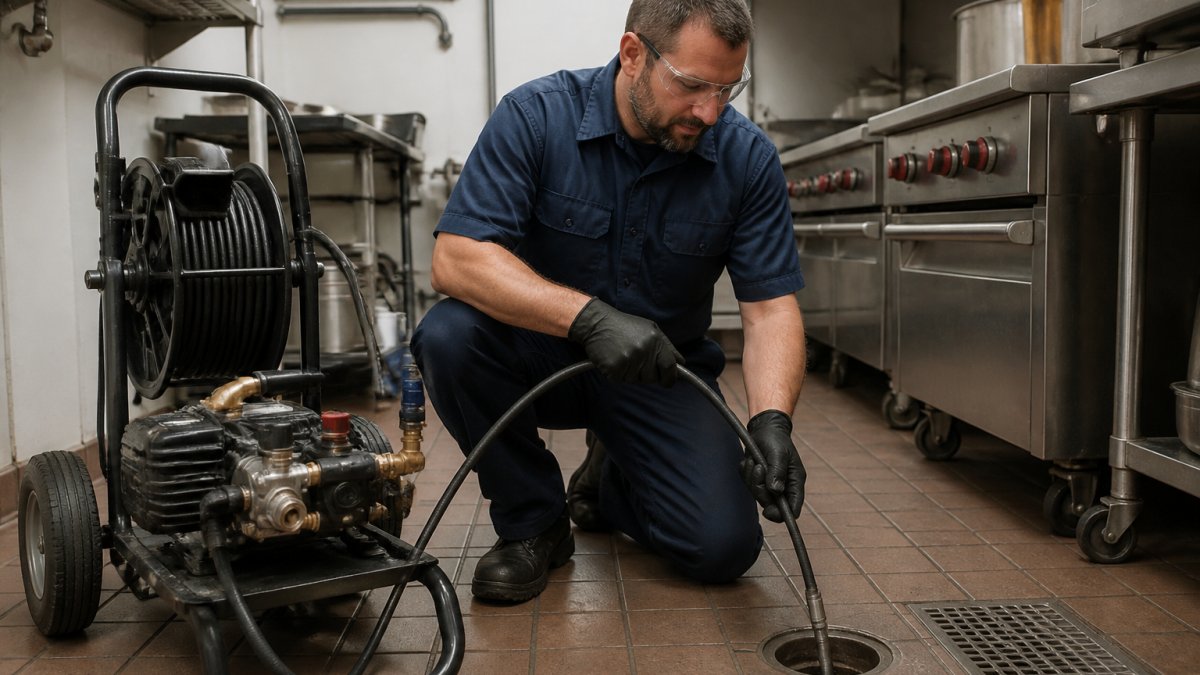
If recurring clogs are the problem, professional hydro jetting in Pinellas County may be worth considering.
Commercial Sewer Camera Inspection Before You Commit to a Repair
A sewer camera inspection is a video survey of the inside of a drain or sewer line using a camera pushed through the pipe. It can help identify problems before a repair is quoted.
Older lines and mature trees are the classic combination.
Before approving a major repair, you may want to schedule a sewer camera inspection in Pinellas County.
How to Compare Commercial Plumbing Contractors and Bids
Comparing contractors comes down to three things: credentials, scope, and how clearly the bid explains what is and is not included. Price alone tells you almost nothing, because the cheapest bid is often the one with the most exclusions.
Use this comparison framework:
| What to Check | Why It Matters | Red Flag |
|---|---|---|
| License and insurance | Protects you if something goes wrong | Won’t provide certificates |
| Written scope of work | Defines what you’re paying for | Vague line items |
| Permit handling | Code compliance and inspection | “Permits not included” buried in fine print |
| Response time | Emergency readiness | No after-hours contact |
| Warranty terms | Recourse on labor and parts | No warranty in writing |
| References | Track record on similar buildings | No commercial references |
Licensing, Insurance, and Permit Checks
Always verify a contractor’s license number directly with the issuing authority, and ask for a certificate of insurance showing general liability and workers’ compensation coverage. You can review Florida’s plumbing license requirements to confirm what to check.
Permits matter. Unpermitted gas or plumbing work can fail inspection and complicate a sale.
Reading a Commercial Plumbing Estimate
A commercial plumbing estimate should separate labor, materials, equipment, and permits. Look for an explicit statement about what happens if hidden damage is found, and a clear payment schedule.
Ask each contractor the same three questions: What is excluded? What triggers a change order? Who handles the inspection? The answers reveal more than the total at the bottom.
How to Compare Bids on Total Cost, Not Sticker Price
The lowest bid is rarely the lowest cost. When you line up two or three estimates, normalize them before you decide:
- Scope exclusions. One bid may include permit fees, haul-away, and patching; another may list them as extras. Add the likely extras to each bid so you compare like with like.
- Materials and fixtures. A bid that uses builder-grade fixtures and another that specifies commercial-grade fixtures are not the same job. Ask for brand and model numbers.
- Warranty and callbacks. Ask each contractor what warranty they provide and whether follow-up callbacks are covered.
- Downtime. For a restaurant or retail space, every day of closure is a cost. A slightly higher bid that finishes in two days can beat a cheaper bid that stretches to five.
- Change-order language. Hidden damage is common in older buildings. A fair contract states how change orders are priced and approved before work continues.
The point is to compare the same scope across every bid rather than picking by the lowest number.
Never approve a commercial repair based on a verbal estimate. Get the scope, exclusions, payment schedule, and warranty in writing before any work begins. If a contractor resists putting terms in writing, that is your answer.
Questions That Reveal a Contractor’s Commercial Experience
Ask each contractor the same set of questions and compare the answers side by side:
- Which building types do you work in most often, and can you share two references in mine?
- Who pulls the permit, and who meets the inspector?
- What is your after-hours response time, and is there a dispatch fee?
- How do you price a job when you open a wall and find corroded pipe?
- What warranty do you provide on labor and on parts?
The contractor who answers these specifically, in writing, is usually the one who has done this before.
Book an Appointment with CW Plumbing
Choosing a plumbing contractor is a decision about who you call at the worst possible moment. CW Plumbing is a family and locally owned business serving commercial and residential clients throughout Pinellas County, with hydro jetting and sewer camera inspection services and emergency service available.
Get started with CW Plumbing to keep your building running. Contact our team to book an appointment.
Frequently Asked Questions
What services do commercial plumbing contractors provide?
Commercial plumbing contractors handle work that goes beyond a residential service call, including repair, remodeling, and drain service. Many offer emergency plumbing service, plus scheduled commercial plumbing maintenance. Ask for a written scope before work starts so you know which of these are included.
How do I choose a commercial plumber for my business?
Start with credentials: confirm the contractor holds a state-certified license and carries insurance, then verify the license number rather than taking a verbal assurance. Next, ask how they handle commercial property work specifically, including after-hours access and tenant coordination. Request a written estimate with line items, not a lump sum. Ask for response times on emergency calls and whether the same crew returns for follow-up. A provider that answers these questions in writing is easier to hold to the job.
How can I compare commercial plumbing estimates?
Put every bid on the same sheet. Confirm each one covers the same scope, the same fixtures or pipe runs, permit fees, and disposal. Look at what is excluded, because a low bid often leaves out patching, after-hours labor, or a follow-up visit. Ask each contractor to state the warranty period and whether the estimate is fixed or time-and-materials. Pricing depends on the building, the access, and the scope, so get the numbers in writing and compare the exclusions as closely as the totals.
Do commercial plumbers handle sewer camera inspections?
Yes. A commercial sewer camera inspection pushes a camera through the line so the plumber can see roots, cracks, bellies, and grease buildup before recommending a repair. This matters on older lines where a repeat clog may be a structural problem rather than a blockage. Ask for the footage and a written summary of what was found.
