


Book An
Appointment
Lorem ipsum dolor sit amet, consectetur adipiscing elit, sed do eiusmod tempor incididunt ut labore et
Our Services
Last Updated: November 15, 2026
Quick Summary
To choose a plumber for a condo renovation, first confirm current licensing, liability insurance and workers’ compensation coverage, then check for experience with shared stacks and risers. Get the HOA alteration approval in writing and make sure the plumber pulls the required permit.
- Ask for the declaration, bylaws, rules and alteration application before requesting quotes.
- Verify the state license number online and request a certificate of general liability insurance.
- Ask how many condo or multi-unit renovations the company completed in the last year.
- Get at least three written quotes that cover the same scope of work.
- Confirm the permit is closed out after the final inspection before making the final payment.
Table of Contents
- Why Condo Plumbing Renovations Need a Different Approach
- Step 1: Verify Licensing, Insurance and Credentials
- Step 2: Confirm Plumbing Permit Requirements in Pinellas County
- Step 3: Evaluate Experience, References and Condo Project History
- Step 4: Request Written Quotes and Understand the Scope of Work
- Step 5: Check Communication, Timelines and the Service Agreement
- Scheduling Your Condo Plumbing Consultation with CW Plumbing
- Frequently Asked Questions
Choosing a plumber for a condo renovation is not the same as hiring one for a leaky faucet in a single-family home, so careful thought about how to choose a plumber matters more here. Condo work often touches shared walls, stacks and risers that serve neighbors, and the building association may have its own rules about when and how work can be done. This guide will help you screen plumbers before you sign anything.
Start with the basics. When you choose a plumber for your condo, look for current licensing, liability insurance and workers’ compensation coverage, a track record with projects like yours, a written scope of work, and clear communication. Work through the steps below in order, and ask for paperwork at each stage.
Why Condo Plumbing Renovations Need a Different Approach
A condo is shared infrastructure wrapped around your unit. Water lines, drain stacks and vents often run through common areas or into the unit next door, and the building’s declaration, not your preference, decides who may touch what. A small mistake in a shared stack can send water into a neighbor’s ceiling, and in a condo that is rarely just a repair problem; it becomes an insurance and liability problem.
Three things separate condo renovation plumbing from single-family work:
- Shared stacks and risers. In most multi-story Pinellas County buildings, the vertical drain stack and the vent stack serve every unit on the line. Cutting into a stack, moving a fixture that ties into it, or changing a vent requires coordination with the association and often a licensed plumber who has worked in occupied multi-unit buildings. A plumber who only does single-family re-pipes may not have done this work.
- HOA alteration approval. Most condo associations require written approval before any alteration that touches common elements or affects the structure. The declaration and the association’s rules typically spell out what counts as an alteration, what drawings or contractor information must be submitted, and how long the board has to respond. Ask for the alteration application and the review timeline before you request quotes, because the approval clock can run longer than the plumbing work itself.
- Insurance and neighbor damage. Your unit-owner policy and the association’s master policy split responsibility in ways that are not obvious. Many associations require a certificate of insurance naming the association as additional insured before a contractor can start, and some require the contractor to carry a specific minimum limit. If a shared pipe fails during your renovation and damages a neighbor’s unit, the question of who pays can turn on whether the work was permitted, whether the contractor was insured, and whether the association approved the scope.
Before you call a plumber, pull three documents: the declaration and bylaws, the current rules and regulations, and the alteration or renovation application. From those, answer four questions in writing:
- Which pipes are your responsibility and which belong to the association?
- What work hours, elevator use and water-shutoff notice does the building require?
- What insurance certificate and license information must the contractor submit?
- Does the board require plans, a permit copy, or a post-work inspection before walls are closed?
A plumber who has done condo work will recognize these questions and can usually tell you what the building will ask for. A plumber who has only done single-family work may not, and that difference shows up later as delays, failed inspections, or a dispute with the board.
Watch out: A verbal “you’re fine to proceed” from a board member or property manager is not approval. Get the alteration approval in writing before demolition starts, because an unapproved change to a common element can be ordered reversed at your expense.
Step 1: Verify Licensing, Insurance and Credentials
Before you compare prices, confirm the plumber is legally allowed to do the work.
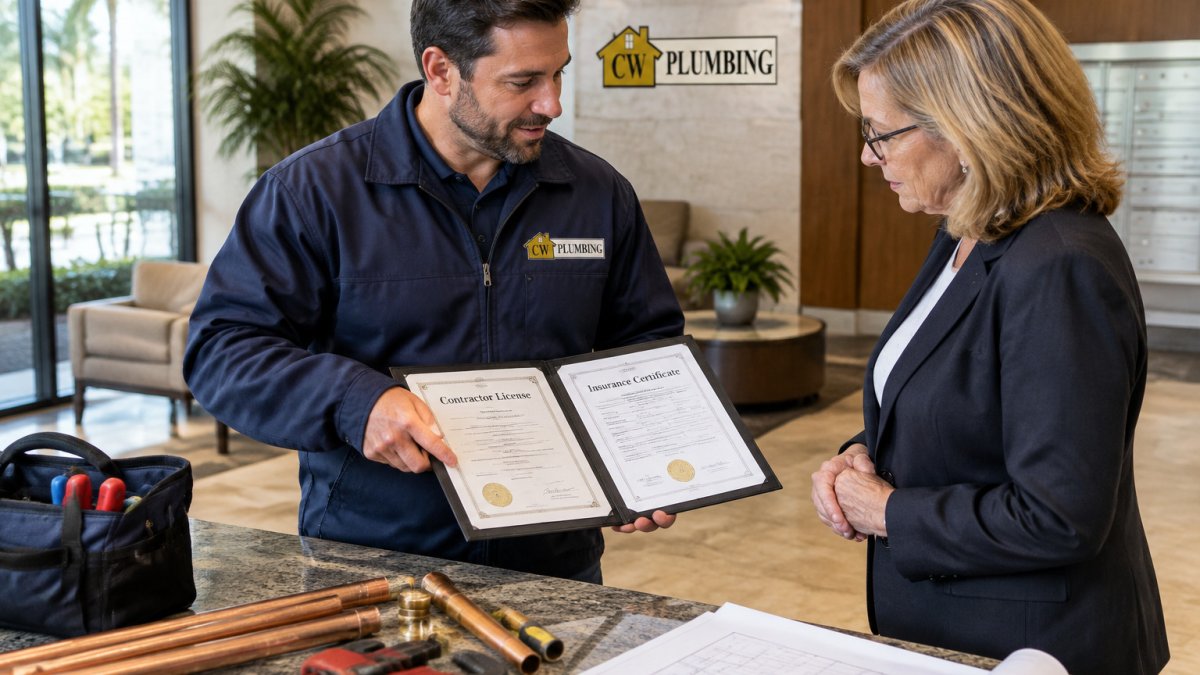
Ask for proof of general liability insurance and workers’ compensation coverage. If a worker is injured on your property and the contractor has no coverage, you could end up responsible.
- Current state license number, checked online
- Certificate of general liability insurance
- Proof of workers’ compensation coverage or an exemption
- Name of the qualifying master or journeyman plumber on the license
Step 2: Confirm Plumbing Permit Requirements in Pinellas County
Many plumbing changes need a permit from the local building department before work starts and an inspection before walls are closed. Which local building office has jurisdiction depends on the property’s address, so confirm that first, a plumber who quotes a permit fee without knowing which jurisdiction applies has not done the homework.
As a rule of thumb, these usually require a permit:
- Adding, moving or removing fixtures (sinks, toilets, showers, tubs, water heaters)
- Replacing or relocating drain lines, water supply lines, or vent stacks
- Re-piping any part of the system
- Any work that ties into a shared stack or common element
Simple fixture swaps, replacing a faucet or a toilet in the same location, often do not require a permit, but the line between “swap” and “alteration” is exactly where condo owners get into trouble. Ask the plumber to state in writing whether a permit is required for your specific scope and, if not, why not.
Ask three questions before you sign:
- Who pulls the permit? The licensed contractor should pull it in the company’s name, not ask you to pull an owner-builder permit. An owner-builder permit shifts inspection responsibility and warranty exposure onto you.
- Is the permit fee in the quote? Permit fees vary with the scope and are set by the jurisdiction, so ask for the fee as a separate line item rather than bundled into labor.
- Who meets the inspector? The plumber should be on site for the rough-in and final inspections. If the crew leaves before inspection, failed items become your problem.
You can verify the contractor’s state license and confirm the permit record through the official state and local licensing and building authorities. Ask for the permit number once it is issued and keep it with your project file.
Watch out: A permit that is not closed out after the final inspection can still show up during a home sale or an insurance claim. Ask for the final inspection record, not just the permit number, and confirm the permit status shows as closed before you make the final payment.
Step 3: Evaluate Experience, References and Condo Project History
General plumbing experience is not enough. Ask whether the company has completed renovations in condos or multi-unit buildings, and what challenges came up. Good answers mention shared risers, tight access, noise limits and coordinating with building management.
Ask for references from recent condo projects, and call them. Good questions include whether the work finished on schedule, how the crew handled the building’s rules, and whether any problems came up after the job.
- Ask how many condo or multi-unit renovations they completed in the last year.
- Request references from at least two of those projects.
- Ask how they protected neighboring units during demolition.
Step 4: Request Written Quotes and Understand the Scope of Work
Get at least three written quotes, and make sure each one describes the same work. A low number often means something is missing. Compare the scope line by line: fixtures, pipe materials, rough-in work, permit fees, cleanup and warranty terms.
Pricing depends on the size of the job, existing conditions, fixture choices and how much access the crew has. To get a current price for your project, contact CW Plumbing directly for a written quote.
Typical Pricing Structures for Renovation Plumbing
Plumbers usually price renovation work in one of three ways. Each can be fair, but they shift risk in different directions.
- Flat fee: One price for a defined scope. Good when the work is clearly described.
- Time and materials: Billed by the hour plus parts. Can cost more if the job takes longer than expected.
- Hybrid: A flat fee for known work, with hourly billing for hidden problems. Ask what triggers the extra charges.
Ask for a written change-order process so you approve any added cost before the work is done.
The three common pricing structures compare as follows:
| Pricing structure | How it is billed | Key risk |
|---|---|---|
| Flat fee | One price for a defined scope | Works best when the scope is clearly described |
| Time and materials | Hourly labor plus parts | Costs more if the job runs longer than expected |
| Hybrid | Flat fee for known work, hourly for hidden problems | Ask what triggers the extra charges |
Step 5: Check Communication, Timelines and the Service Agreement
A clear service agreement protects both sides. It should list the scope, the start and finish dates, payment schedule, warranty terms and who handles building coordination. Read it before you sign, and keep a copy.
Notice how the company responds to your questions during the quoting process. Slow or vague answers before the job often predict problems during it. Ask who your point of contact will be and how quickly they return calls.
- Start and estimated completion dates in writing
- Payment schedule tied to completed milestones, not large upfront deposits
- Warranty on labor and parts, with the length stated
- Plan for water shutoffs and access to the unit
Scheduling Your Condo Plumbing Consultation with CW Plumbing
If you are planning a kitchen or bathroom remodel in a Pinellas County condo, CW Plumbing can review your plans and give you a written quote with a clear scope of work. We are a family and locally owned business providing residential and commercial plumbing services.
To start, book your consultation and we will walk you through what to expect, or review our full range of plumbing services before you call. You can also check the Florida plumbing license requirements so you know what a valid license looks like.
Frequently Asked Questions
Do I need a licensed plumber for a condo renovation in Florida?
Yes. Plumbing work generally requires a licensed contractor, and most condo associations require proof of both a valid license and liability insurance before any work begins. Ask the plumber for their license number and verify it through the state licensing records. Also confirm that they carry general liability and workers compensation coverage, and request certificates naming the condo association as an additional insured where the association asks for it. Working with an unlicensed or uninsured person can leave you responsible for damage to neighboring units.
What are the specific plumbing challenges in Pinellas County condo renovations?
Condo plumbing often runs through shared risers, stacks and walls that serve neighboring units, so a renovation can affect people outside your own unit. Many older buildings have cast iron or galvanized pipes that may need replacement during a bathroom or kitchen remodel. Access is often limited to a single elevator and a set work window, and the building’s rules may restrict noisy work or water shutoffs. A plumber familiar with condo association requirements can plan shutoffs and inspections around these constraints.
Are there specific building codes for condo plumbing in Pinellas County?
Plumbing alterations generally require a permit and inspection from the local building authority, which depends on the property’s location. Condo associations often add their own rules on work hours, contractor insurance and changes to shared plumbing. Ask your plumber who pulls the permit, when inspections occur, and whether the association must approve the work before the permit is issued.
How much does a condo bathroom renovation plumbing job cost?
Pricing depends on the number of fixtures moved, whether shared lines must be opened, the age and material of the existing pipes, permit fees and how much access the building allows. CW Plumbing does not publish fixed prices for this work, so the most reliable way to plan your budget is to request a written quote that itemizes labor, materials, permits and any allowance for unforeseen conditions. For current pricing or a quote, contact CW Plumbing directly through its website.
