


Book An
Appointment
Lorem ipsum dolor sit amet, consectetur adipiscing elit, sed do eiusmod tempor incididunt ut labore et
Our Services
Table of Contents
- Why Plumbing Is the Line Item That Breaks Bathroom Budgets
- What Actually Drives Your Remodel Plumbing Cost
- Bathroom Rough-In Plumbing Cost: Where the Real Money Goes
- Cost to Move Plumbing in a Bathroom: Toilet, Sink, and Shower Relocation
- Hiring a Licensed Plumber for Renovation: What to Verify First
- DIY vs. Professional Plumbing: Where the Risk Outweighs the Savings
- Water-Efficient Fixtures and the Long-Term Payback
- Hidden Costs, Contingency Budgets, and Resale Value
- Frequently Asked Questions
Last Updated: October 4, 2026
Why Plumbing Is the Line Item That Breaks Bathroom Budgets
A bathroom remodel plumbing cost guide exists because plumbing is the one line item that can turn a tidy renovation into a financial surprise. Tile and paint are predictable. Pipes behind the wall are not.
That discovery changes everything.
Most remodeling budgets treat plumbing as a small line item. In practice, it is the line that decides whether your project stays on schedule or stalls for a week. HUD’s guidance on home improvement financing notes that unexpected repair costs are a leading reason renovation loans run short.
So this guide separates cosmetic spending from structural plumbing work. That distinction is where most budgets fail.
What Actually Drives Your Remodel Plumbing Cost
Three things drive your remodel plumbing cost: how much pipe you move, what the local labor rate is, and how much material the job requires. Everything else is a smaller factor.
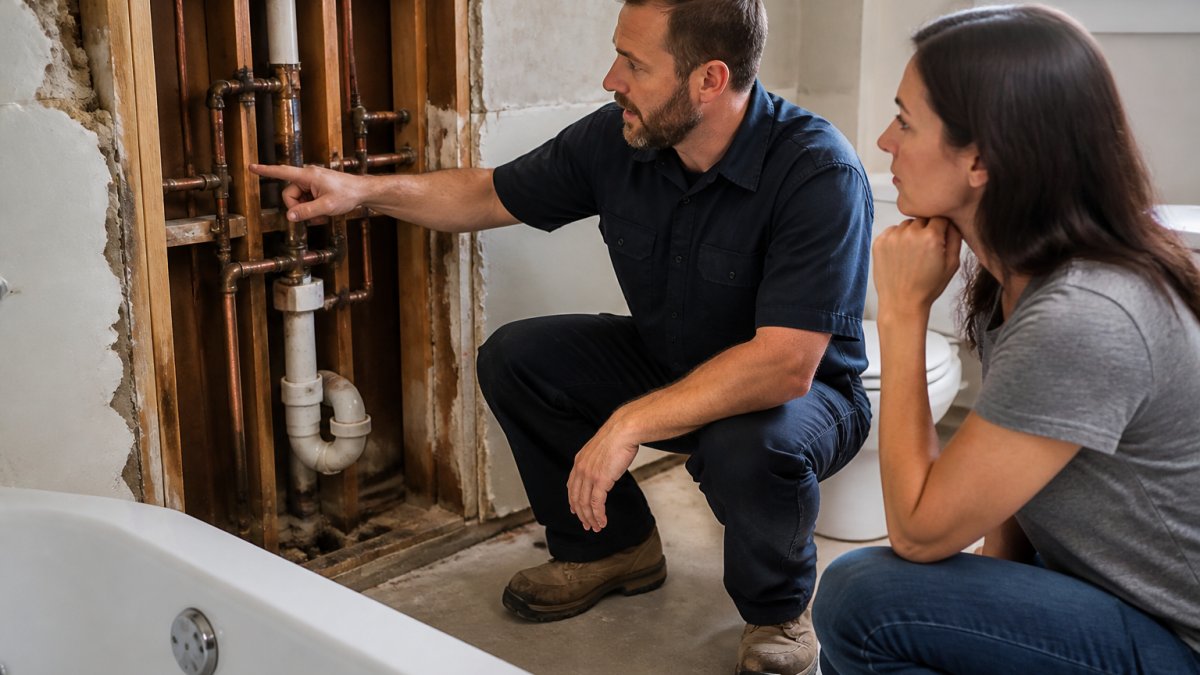
Rough-In Work vs. Fixture Replacement
Rough-in plumbing is the pipe work inside the wall: supply lines, drainage, and venting. Fixture replacement is swapping the toilet, sink, or shower for a new one in the same spot.
Rough-in costs far more. It involves opening walls, cutting pipe, and passing inspection. Fixture replacement is mostly labor and the fixture itself.
Labor Rates, Permits, and Material Markup
A licensed plumber bills by the hour, and rates vary by market and job complexity. A plumbing permit adds a fee and an inspection step. Material markup covers fittings, pipe, and valves.
| Cost Driver | What It Covers | Budget Impact |
|---|---|---|
| Rough-in work | Supply lines, drainage, venting | Highest |
| Fixture replacement | Toilet, sink, shower swap | Moderate |
| Labor rate | Licensed plumber’s hourly time | High |
| Plumbing permit | Local fee plus inspection | Low to moderate |
| Material markup | Pipe, fittings, valves | Moderate |
Ask your plumber to separate rough-in labor from fixture labor on the estimate. It makes it obvious which part of the quote is structural and which is cosmetic.
Bathroom Rough-In Plumbing Cost: Where the Real Money Goes
Bathroom rough-in plumbing cost is the largest single plumbing expense in most remodels, and it is also the line item most often underestimated. Rough-in covers the pipe you never see once the walls close: supply lines, drain and waste pipe, venting, and the waterproofing that ties into the shower or tub assembly.
The work typically includes:
- New hot and cold supply lines run from the existing branch to each fixture location
- Drain and waste pipe sized to code for the fixture it serves
- Venting tied into the existing drain-waste-vent (DWV) system so traps do not siphon
What Actually Drives Rough-In Cost
Four variables move the number more than anything else:
- How many fixtures move. A single fixture relocation is a contained job. Moving the toilet, sink, and shower together means re-running the whole wet wall.
- How far the drain travels. Drain pipe must maintain slope (commonly 1/4 inch per foot for 2-inch and smaller pipe under most adopted model codes). Every extra foot of horizontal run eats vertical drop you may not have.
- Whether the vent stack moves. Tying into an existing vent is far cheaper than cutting a new one through the roof or re-routing around framing.
- How the wall opens. A clean access panel or a planned wall removal is cheaper than exploratory demolition through finished tile.
Rough-In Cost by Fixture
| Fixture | Typical Rough-In Scope | Relative Cost |
|---|---|---|
| Toilet (same spot) | New flange, supply, wax ring, no drain move | Lowest |
| Toilet (relocated) | New drain run with slope, new vent tie-in, floor patch | Highest |
| Sink / vanity | Supply extensions, new drain arm, P-trap alignment | Low to moderate |
| Shower or tub | New drain, pan, waterproofing, valve rough-in | Moderate to high |
| Freestanding tub | New floor drain, supply stub-outs, filler rough-in | High |
Moving the drain-waste-vent stack is the priciest single task. It runs through framing, often requires a permit and inspection, and can force ceiling or floor repairs in the room below. International Code Council plumbing code resources publishes the model codes many jurisdictions adopt, which is why venting and slope rules vary by location.
Rough-In vs. Cosmetic: Why the Distinction Matters for ROI
Most cost guides lump plumbing into one line. That hides the fact that rough-in and cosmetic plumbing have very different returns.
- Cosmetic plumbing (new faucet, new showerhead, new toilet in the same spot) improves how the room looks and feels. It rarely moves resale value on its own.
- Structural plumbing (new supply lines, corrected drain slope, replaced galvanized or polybutylene pipe, proper venting) is what inspectors and buyers actually pay attention to. Updated supply and drain lines read as a maintained home; original mid-century pipe reads as deferred maintenance.
A practical way to think about it: cosmetic plumbing is a finish decision, structural plumbing is an asset decision. If your budget only stretches to one, structural work protects the value of everything you put on top of it.
Skipping the permit to save a fee is a real mistake. Unpermitted plumbing can fail a future home inspection, stall a sale, and force the buyer’s lender to require a retroactive fix at your expense.
Cost to Move Plumbing in a Bathroom: Toilet, Sink, and Shower Relocation
The cost to move plumbing in a bathroom depends on distance and direction. A short shift on the same wall is cheaper than crossing the room.
Here is how the three common moves compare:
| Move | Difficulty | Why |
|---|---|---|
| Toilet relocation | High | Needs a new drain slope and vent |
| Sink relocation | Moderate | Supply lines are easier to extend |
| Shower conversion | Moderate to high | Waterproofing and drain must be redone |
Toilet relocation is the hardest. The drain needs a proper slope, and the vent must stay connected.
A shower conversion adds waterproofing work on top of plumbing. That step protects the subfloor and the room below.
Hiring a Licensed Plumber for Renovation: What to Verify First
Hiring a licensed plumber for renovation starts with three checks: license, insurance, and permit handling. Ask for all three before work begins.
- Confirm the license is active and current
- Ask for proof of insurance
- Confirm who pulls the plumbing permit
A licensed plumber protects you if something goes wrong during the remodel. Insurance covers damage. The permit keeps the work legal.
The cheapest bid often skips the permit and the insurance. That savings disappears the moment a pipe leaks behind a finished wall.
DIY vs. Professional Plumbing: Where the Risk Outweighs the Savings
Most guides answer this question with a slogan: “DIY the easy stuff, hire out the hard stuff.” That is not useful when you are standing in a hardware aisle trying to decide whether a task is easy or hard. A better framework is to sort tasks by three questions:
- Does it require a permit? If yes, it is not a DIY task in most jurisdictions, regardless of skill.
- Does it touch the drain-waste-vent system? Venting and drain slope are the two areas where small mistakes cause large, hidden problems.
- If it fails, does it fail visibly or behind a wall? A leaking faucet is annoying. A leaking supply line inside a wall is a mold and structural problem.
Task-by-Task Risk Assessment
| Task | Permit Likely? | DIY Reasonable? | Why |
|---|---|---|---|
| Replace faucet or showerhead | No | Yes | Threaded connection, no code impact |
| Replace toilet in same spot | Sometimes | Usually | Same flange and supply; watch the wax ring and shutoff valve |
| Replace vanity and sink | Sometimes | Usually | Supply and drain align if the footprint matches |
| Swap a shutoff valve | No | Yes, with care | Requires shutting off the main; soldered or push-fit options vary |
| Move a drain or toilet | Yes | No | Slope, venting, and inspection are all code-driven |
| Cut into or re-route a vent stack | Yes | No | Venting errors cause sewer gas and trap siphonage |
| Run new supply lines | Yes | No | Pressure testing and material compatibility matter |
| Replace galvanized or polybutylene pipe | Yes | No | Whole-system material change; often triggers inspection |
The Insurance and Code Consequences
Two things most homeowners do not learn until it is too late:
- Insurance. A homeowner’s policy may deny a water-damage claim if the loss traces to unpermitted or non-code plumbing work. The savings from skipping a permit can be erased by a single denied claim.
- Code and disclosure. When you sell, most states require disclosure of known material defects and unpermitted work. A buyer’s inspector who flags unpermitted plumbing can force a price reduction or a retroactive fix.
When You Actually Need a Licensed Master Plumber
Licensing structures vary by state, but the pattern is consistent: a journeyman plumber works under supervision, and a master plumber is the one who can pull permits, supervise, and sign off on code compliance. For a remodel that moves drains, vents, or supply lines, you want the permit pulled by a licensed plumber, and in many jurisdictions, that means a master.
Before hiring, verify:
- Active license number, checked against the state licensing board
- General liability and workers’ compensation insurance
- Who pulls the plumbing permit (it should be the licensed plumber, not you)
Water-Efficient Fixtures and the Long-Term Payback
Water-efficient fixtures cut long-term utility costs, which offsets part of the upfront plumbing spend. Low-flow toilets and showerheads use less water per flush and per minute.
The payback shows up on every utility bill, month after month. That is a different kind of return than resale value. It is money you keep.
EPA WaterSense program for efficient fixtures labels fixtures that meet water-efficiency standards, which makes them easier to compare.
Hidden Costs, Contingency Budgets, and Resale Value
Hidden costs come from what the walls hide: old pipe, prior DIY work, or water damage. A contingency budget covers those surprises.
Set aside a cushion before demolition starts. When the wall opens, you will know if the drain or supply lines need replacement.
Updated plumbing supports resale value and home equity. Buyers and inspectors look at pipe material and water pressure.
Photograph the open wall before it closes. Those photos document the new piping material for future buyers and inspectors.
Frequently Asked Questions
How much does it cost to redo plumbing in a bathroom?
There is no single number. Remodel plumbing cost depends on whether you are replacing fixtures on existing lines or cutting into the floor for new rough-in work. A cosmetic swap of a faucet or toilet keeps labor low because the supply lines and drainage system stay put. Moving a toilet, converting a tub to a shower, or adding a second sink means new piping, venting requirements, and a plumbing permit, which pushes the project into a different tier. CW Plumbing can walk through your bathroom and give you a written scope before any work starts.
What is the most expensive part of a bathroom remodel?
Structural plumbing, not the tile. Demolition costs, relocating a drain-waste-vent line, and re-running supply lines through finished walls are the items that escalate fastest. Fixtures themselves are predictable: you can price a vanity, faucet, or toilet in advance. What you cannot price until the wall is open is what the existing piping looks like underneath. That is why a contingency budget of 15 to 20 percent of the total project cost is standard advice, and why a plumbing inspection before demolition saves money.
Does moving bathroom fixtures significantly increase plumbing costs?
Yes. Moving any fixture away from its existing drain adds cost because the drainage system relies on gravity and specific pipe slope. A relocated toilet or shower needs a new drain path, new venting requirements, and often floor or joist work. Keeping fixtures in roughly the same footprint is the single biggest way to control cost to move plumbing in bathroom projects. If the layout has to change, get the rough-in priced separately from the finish work so you can see exactly what the move costs.
How do I verify a plumber is licensed and insured before renovation work begins?
Ask for the license number and confirm it with your state or local licensing authority, then request a certificate of insurance showing both general liability and workers’ compensation coverage. Hiring a licensed plumber for renovation also means the permit gets pulled in the right name, which matters at resale and if an inspection fails. A licensed plumber will also flag building codes issues during the estimate rather than after demolition. Get the scope, the permit responsibility, and the payment schedule in writing before work starts.
A bathroom remodel can stall fast when hidden plumbing problems surface mid-project. CW Plumbing is a family and locally owned business serving Pinellas County, with hydro jetting and sewer camera inspection equipment to find issues before they grow. Our team handles kitchen and bathroom remodeling for homes and businesses alike. Book an appointment with CW Plumbing and keep your remodel on schedule.