


Book An
Appointment
Lorem ipsum dolor sit amet, consectetur adipiscing elit, sed do eiusmod tempor incididunt ut labore et
Our Services
Last Updated: November 19, 2026
Quick Summary
Water heater maintenance is one of the cheapest things a homeowner can pay for, and it prevents larger bills from a failed unit. Exact cost depends on unit type, age, access and the work found on site, so a written quote from a licensed plumber gives the reliable number.
- Routine maintenance covers inspection, the pressure relief valve, sediment flushing and anode rod testing.
- Repairs such as a failed heating element, leaking tank or bad thermostat are separate jobs with their own cost.
- Tank units need a yearly flush, while tankless units need periodic descaling of the heat exchanger.
- Tank size, sediment load, access and scheduling all affect a water heater flush price.
- Compare quotes line by line, covering the flush, inspection, relief-valve test, anode-rod check and any trip fee.
Table of Contents
- What Water Heater Maintenance Costs in Pinellas Park
- What a Routine Maintenance Visit Includes
- Tank Versus Tankless: How Maintenance Costs Differ
- Water Heater Flush Cost Near Me: Pricing Factors
- Signs Your Water Heater Is Failing and When Repair Costs Add Up
- Repair Versus Replacement: Comparing Long-Term Costs
- Booking Your Water Heater Service With CW Plumbing
- Frequently Asked Questions
What Water Heater Maintenance Costs in Pinellas Park
Water heater maintenance is one of the cheapest things a homeowner can pay for, and one of the easiest to skip. Pinellas Park homeowners who stay on top of it tend to avoid the larger bills that come from a failed unit. CW Plumbing serves homeowners and businesses across Pinellas County, so the questions below come up often.
The final bill depends on the unit type, its age, access and the work found on site. A quote from CW Plumbing is the reliable way to get a current number for your home, and you can check our website for current pricing or request a quote. What you can do now is understand which costs are routine and which are repairs, so you know what to expect when you call.
Maintenance covers a few routine tasks: inspecting the unit, checking the pressure relief valve, flushing sediment and testing the anode rod. Repairs are different. A failed heating element, a leaking tank or a bad thermostat is a separate job with its own cost. Keeping those two categories apart makes it easier to read any quote you receive.
What a Routine Maintenance Visit Includes
A routine visit is a checkup, not a rebuild. The plumber shuts off power or gas, drains a few gallons from the tank to check for sediment, and looks at the valves, connections and the area around the unit for moisture or corrosion.
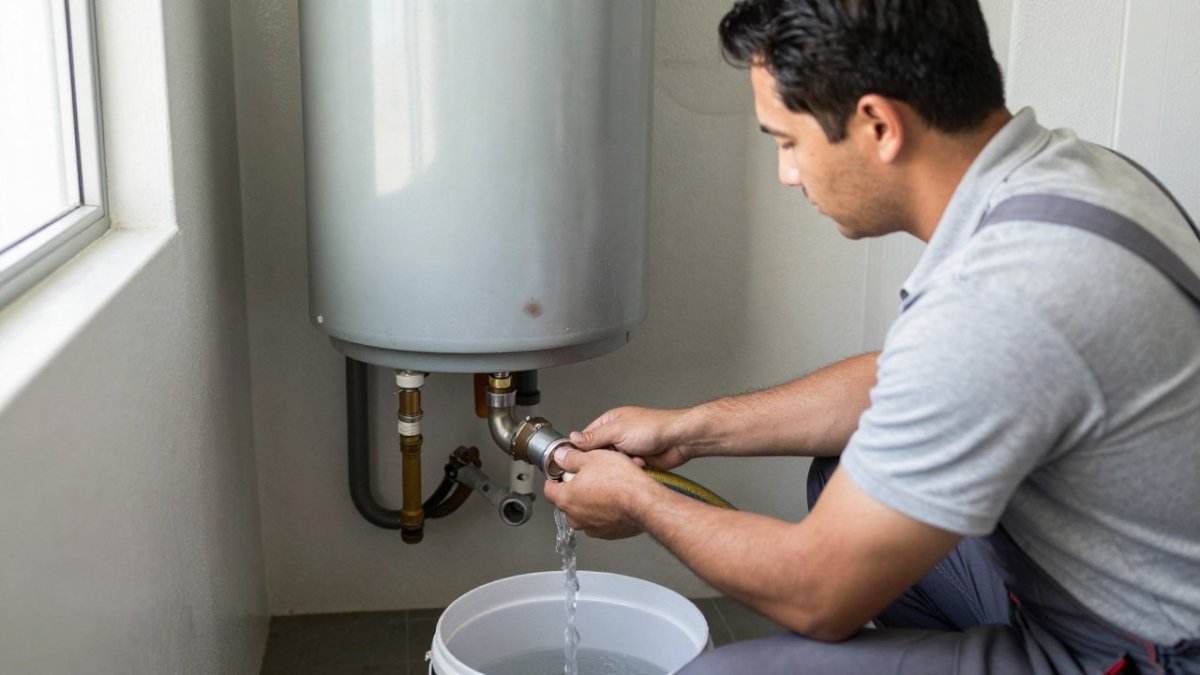
Most visits also include testing the temperature and pressure relief valve and checking the anode rod. The anode rod is a metal rod that slows tank corrosion, and it wears out over time. Replacing it early is usually far cheaper than replacing the tank.
Ask your plumber to write down what was checked and what was found. A clear list makes it easy to compare visits year to year and to see whether a problem is growing.
Tank Versus Tankless: How Maintenance Costs Differ
The maintenance bill for a tank and a tankless unit are not the same shape. A tank unit needs a yearly flush, an anode-rod check and a relief-valve test; those tasks are relatively quick, and the anode rod is an inexpensive part when it is replaced on schedule. A tankless unit skips the tank flush but needs periodic descaling of its heat exchanger, a service that requires specialized equipment and more labor time than a tank flush. Review tankless water heater installation costs to see the upfront picture alongside these upkeep needs.
Warranty terms are where the two can differ. Check your manufacturer’s warranty for its maintenance requirements, and keep every invoice and service record regardless of unit type.
Local water conditions can affect the schedule. Water with dissolved minerals forms scale, which can shorten a tankless heat exchanger’s life and slow a tank’s recovery. Homes on private wells, or on older galvanized plumbing, may see sediment faster, so ask your plumber whether a shorter interval makes sense.
A practical way to budget: ask your plumber to quote a yearly tank service and a yearly tankless descale separately, along with the cost of any anode rod or filter replacement. Ask about both a one-time visit and an annual plan, and compare the quotes rather than the sticker price of the unit.
The two unit types need different maintenance, as summarised below.
| Unit type | Main maintenance task | Relative effort |
|---|---|---|
| Tank | Yearly flush, anode-rod check, relief-valve test | Quick tasks; anode rod is inexpensive |
| Tankless | Periodic descaling of heat exchanger | Specialized equipment, more labor time |
Water Heater Flush Cost Near Me: Pricing Factors
A water heater flush is the single most common maintenance task homeowners pay for, and it is also the one where quotes vary the most. Pricing depends on the unit and the visit scope, so the only reliable number is the one a licensed plumber puts in writing after seeing your unit. Contact CW Plumbing or check our website for current pricing or a quote.
Several factors can affect the final cost:
- Tank size and type. A 40-gallon tank flushes faster than an 80-gallon unit, and a tankless heat exchanger descale is a different job with different parts.
- Sediment load. A unit that has never been flushed can take noticeably longer than one serviced every year, because hardened scale at the bottom of the tank has to be broken up before it will drain.
- Access and drainage. A unit in a garage with a nearby floor drain is quick to service. A unit in a closet, attic or second-floor mechanical room may require extra hose runs, a pump, or moving stored items, and that labor shows up on the bill.
- What the visit uncovers. A flush that reveals a seized drain valve, a corroded nipple or a failing relief valve turns into a repair, and parts are billed on top of the flush.
- Scheduling. After-hours, weekend and emergency calls carry premiums that a scheduled weekday visit does not.
Ask specifically what any quoted price includes before you book, including whether the relief-valve test and anode-rod inspection are covered.
When you compare quotes, line up five items side by side: the flush itself, the inspection, the relief-valve test, the anode-rod check, and any diagnostic or trip fee. A quote that lists all five is easier to compare than a single headline price, and it protects you from surprise add-ons. Water conditions matter here too: water with dissolved minerals settles out as sediment, so units on municipal supply still benefit from a yearly flush, and homes on private wells may need closer attention.
Signs Your Water Heater Is Failing and When Repair Costs Add Up
Some symptoms signal a problem that maintenance alone will not fix. Rusty or discolored hot water, popping or rumbling noises from the tank, lukewarm water that runs out quickly, and water pooling around the base are all warning signs. Popping noises usually come from sediment hardening at the bottom of the tank, and they often mean the unit is working harder than it should. Find out what causes popping noises and how to fix them safely.
Repair costs add up when a small problem is ignored. A worn valve or a failing heating element is an inexpensive fix when caught early. Learn the signs your water heater is failing so you can act before a small issue becomes a flood. If the tank itself starts to leak, repair is usually not worth it, and replacement becomes the practical choice.
If you smell gas, see soot, or notice water leaking around a gas unit, shut off the gas supply and call a professional right away. These are safety issues, not scheduling issues.
Repair Versus Replacement: Comparing Long-Term Costs
The choice between repair and replacement comes down to the unit’s age, the cost of the repair and how well the unit has been maintained. A repair on a young, well-maintained unit often makes sense. A major repair on an old unit usually does not, because another part is likely to fail soon.
A simple test: if the repair costs a large share of a new unit, and the unit is near the end of its typical service life, replacement is usually the better long-term choice. Ask your plumber to explain both options with real numbers before you decide.
Replacement also gives you a chance to pick a more efficient unit or switch between tank and tankless. Compare the upfront cost against several years of running and maintenance costs, not just the purchase price.
Booking Your Water Heater Service With CW Plumbing
If you are ready to schedule a checkup, flush or repair, CW Plumbing can inspect your unit and give you a written quote before any work begins. Our team serves Pinellas County homes and businesses, and we handle everything from routine maintenance to emergency repairs. Book water heater service in Pinellas County to get started.
Frequently Asked Questions
How often should water heaters be serviced?
Most manufacturers recommend a professional inspection and flush about once a year for tank water heaters, and sooner in areas with hard water. Check your owner’s manual for the specific interval for your unit, and keep records of each service. Tankless units usually need descaling every one to two years, depending on water hardness and use. Scheduling service before problems appear is generally less costly than repairing a failed component.
Should I flush a water heater that is over 10 years old?
Flushing an older water heater can help, but it is not always the right move. Sediment and scale can loosen and clog drain valves when a tank has never been serviced, so a plumber should first check the drain valve and tank condition. If the tank is leaking, rusting at the seams, or the anode rod is fully depleted, replacement is often the better investment. Ask for a quote that includes the inspection so you can decide with full information rather than guessing.
Is it cheaper to perform DIY water heater maintenance or hire a professional?
A homeowner can drain a few gallons from a tank to reduce sediment, which costs little beyond time. A full flush, anode rod inspection, pressure relief valve test and burner or element check requires tools, safety knowledge and proper handling of hot water and gas or electrical connections. Mistakes can lead to scalding, leaks or damage that costs more than the professional visit. Pricing for CW Plumbing service depends on the unit type and visit scope, so contact the team for a current quote.
How does hard water in Pinellas Park affect water heater maintenance?
Hard water leaves mineral deposits that settle at the bottom of a tank and coat heating elements or burner areas, which can reduce efficiency and increase the chance of overheating. Tank units in hard-water homes often benefit from more frequent flushing, while tankless units need regular descaling. Over time, sediment accelerates corrosion and can shorten system life. Regular service keeps these issues from turning into costly repairs.
