


Book An
Appointment
Lorem ipsum dolor sit amet, consectetur adipiscing elit, sed do eiusmod tempor incididunt ut labore et
Our Services
Table of Contents
- Why Pipes Make Loud Noises: Start With the Sound
- Water Hammer Causes and Fixes
- Loose Pipework, Fittings, and Supports
- High Water Pressure and Sudden Pressure Changes
- Whistling Water Pipes: What the Pitch Tells You
- Water Running Noise in Walls at Night
- Heating System and Thermal Expansion Noises
- Safe DIY Checks vs. Work for a Plumber
- Frequently Asked Questions
Last Updated: October 18, 2026
Why Pipes Make Loud Noises: Start With the Sound
A loud banging pipe usually isn’t a warning that your plumbing is about to fail.
We hear the same question from homeowners across Pinellas County: “Is that noise normal?” Usually it isn’t dangerous. Sometimes it is.
Below, we’ll show you how to identify each noise, trace its trigger, and decide whether to fix it yourself or call a professional.
Here’s the key insight: the type of noise tells you what’s moving that shouldn’t be. Banging means a pressure wave.
Match the sound to the cause before you touch anything. A banging pipe and a ticking pipe have almost nothing in common, and the fixes don’t overlap.
Water Hammer Causes and Fixes
Water hammer is the sharp bang you hear when a faucet, dishwasher, or washing machine shuts off. Water flowing through a pipe has momentum; when a valve closes fast, that water stops suddenly and the energy has nowhere to go, creating a pressure wave that slams into the pipe walls.
Why the Bang Happens When a Faucet or Appliance Shuts Off
Fast-closing valves cause the worst water hammer. Older toilets with quick-shut fill valves and appliances with solenoid valves are common culprits: the faster the valve closes, the bigger the wave.
Fixes From a Simple Pressure Check to a Hammer Arrestor
Start with the simplest fix and work up:
- Check your water pressure. High water pressure makes water hammer worse. A pressure reading above the normal residential range means the system is working harder than it should. A plumber can test this at an outdoor hose bib.
- Secure loose pipes. A pipe that can move will bang. Adding pipe clips or supports often quiets the knock.
- Install hammer arrestors. These small devices absorb the pressure wave near the appliance. They’re the standard fix for washing machines and dishwashers.
- Replace fast-closing valves. A slower-closing valve reduces the shock.
If the banging happens throughout the house, the cause is usually pressure or loose pipework, not a single appliance. That’s a job for a professional.
Loose Pipework, Fittings, and Supports
The most common cause of rattling and clunking is simple: pipes that aren’t held firmly in place.
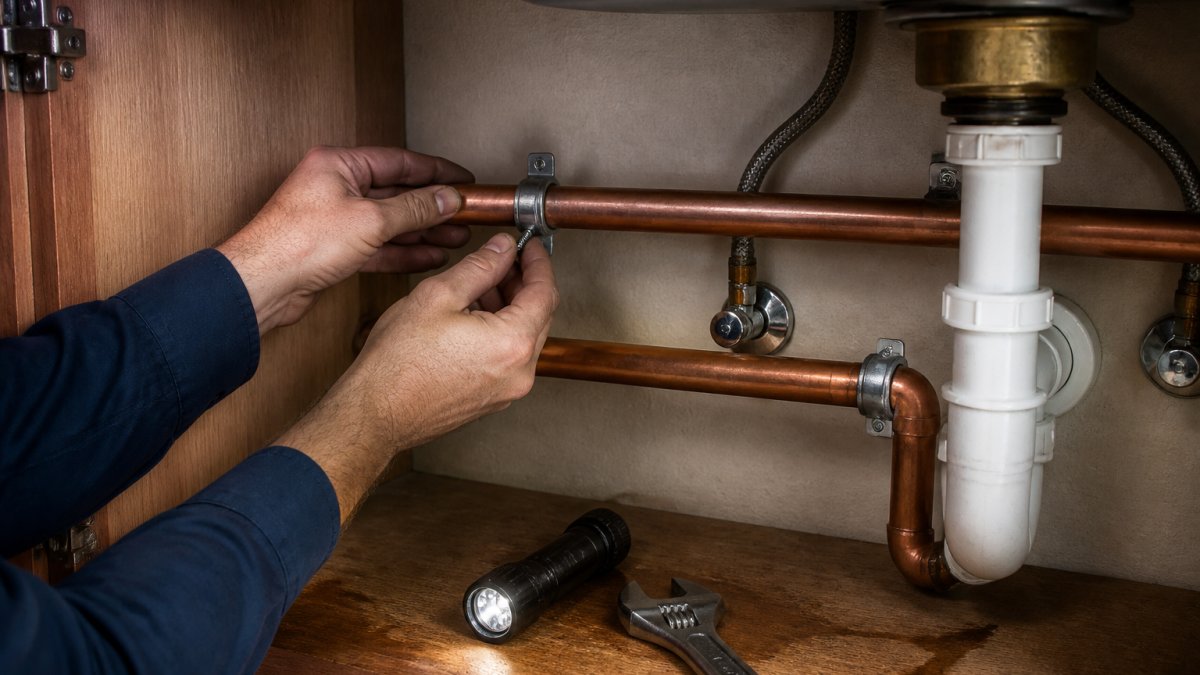
Copper expands when hot water runs through it, and over time that movement loosens clips and supports.
How to Tell Loose Pipework From Water Hammer
Loose pipework and water hammer both produce a knock, but they behave differently:
- Loose pipework: the rattle or knock starts the moment water begins flowing and continues while it flows. It stops when the water stops. It tends to be localized to one wall, one floor, or one run of pipe.
- Water hammer: a single hard bang at the instant a valve closes, not a sustained rattle during flow.
- Thermal ticking: a series of small ticks as hot water heats the pipe, then again as it cools.
If you can put your hand on an accessible pipe and feel it move or buzz while a faucet runs, you’ve found loose pipework. If the noise only happens at shutoff, look at water hammer first.
What Proper Support Looks Like
The right fix depends on the pipe material and where it runs:
- Copper and PEX: plastic or metal clips sized to the pipe, spaced so it can’t sag. Plastic clips are preferred on copper because they avoid metal-to-metal contact that can wear the wall.
- Galvanized steel: metal hangers or straps, often with a dielectric separator to limit corrosion.
- Isolation: where a pipe passes through a stud or joist, a plastic sleeve or grommet keeps it from rubbing on the wood, the most overlooked detail in noisy-pipe repairs.
What You Can Check Safely
You can inspect exposed pipe under sinks, in a basement, crawlspace, or unfinished garage. Look for:
- Clips that have pulled loose from the framing
- Pipe resting directly on a joist with no sleeve
- A run that sags between hangers
In an accessible space, the fix is often just adding or replacing clips. Behind finished drywall, it means opening the wall or ceiling, not complicated, but invasive, and that’s where a professional saves you time and drywall repairs.
Before you assume water hammer, run a faucet and listen. A noise that starts with flow and stops with flow is almost always a loose or unsupported pipe, not a pressure wave.
High Water Pressure and Sudden Pressure Changes
High water pressure is the hidden cause behind a lot of pipe noise. Above the normal range, every valve closure sends a stronger shock through the system and wears out fittings faster. Sudden pressure changes happen when the supply fluctuates, a surging city main or failing pressure regulator sends spikes through your pipes. You’ll notice:
- Banging that seems random
- Noise that’s worse at certain times of day
- Faucets that spit or surge when first opened
A pressure-reducing valve at the main line solves most of this, a small part with a big effect on noise and on the lifespan of your plumbing.
Don’t ignore high water pressure just because the noise is only occasional. Sustained high pressure stresses every joint and supply line in the house, and it’s a common factor in sudden leaks.
Whistling Water Pipes: What the Pitch Tells You
Whistling water pipes mean restricted flow. Water forced through a narrow opening makes a high-pitched sound, and the pitch tells you how severe the restriction is.
A thin, sharp whistle usually points to:
- A partially closed shut-off valve
- A failing valve washer
- Mineral buildup or limescale narrowing the pipe
Start by checking every shut-off valve under sinks and behind toilets, a half-open valve is a common, easy fix.
A whistle that changes pitch with water temperature usually means a failing valve, not a blocked pipe.
Water Running Noise in Walls at Night
Hearing water running inside a wall when nothing is on is the one noise you shouldn’t dismiss, a faint trickle or rush at night usually means a leak.
Common sources:
- A leaking supply line inside the wall
- A running toilet that refills itself repeatedly
- A failing valve that won’t fully close
Timing matters: when the house is quiet and water use is low, a small leak becomes audible, while daytime flow masks it. Check your water meter before bed and again in the morning with nothing running.
A running toilet is the most common cause of nighttime water noise, and it’s the cheapest to rule out. Lift the tank lid and listen. If the fill valve keeps hissing after the tank is full, that’s your culprit.
Heating System and Thermal Expansion Noises
Ticking, creaking, and soft knocking from heating pipes is usually thermal expansion: hot water heats the pipe, the metal expands and slides against its supports, then contracts and ticks as it cools.
What isn’t normal:
- Loud banging in a boiler or furnace
- Knocking that gets worse over time
- Gurgling from radiators
Those point to trapped air, a failing circulator pump, or a pressure problem in the heating loop. Bleeding radiators fixes the gurgling. Banging inside the boiler itself needs a technician.
Separate Heating Noise From Plumbing Noise First
The fastest way to narrow down a noisy system is to ask which system is running when the sound occurs. Plumbing noise comes from pressure and flow; heating noise comes from temperature change and circulation. If the noise appears only after the thermostat calls for heat and stops when the system cycles off, it’s the heating loop. If it happens every time a toilet refills, it’s plumbing.
A Sound-by-Sound Guide to Heating Noises
| Sound | When It Happens | Likely Cause | Next Step |
|---|---|---|---|
| Ticking or creaking | As pipes heat up or cool down | Thermal expansion against supports | Usually normal; check that clips allow movement |
| Gurgling in radiators | When heat starts, or after bleeding | Trapped air in the loop | Bleed the radiators |
| Soft knocking in pipes | During heat-up | Pipe expanding against a tight clip or joist | Add isolation or loosen the clip |
| Loud banging in the boiler | During firing or circulation | Trapped air, failing circulator, or pressure problem | Call a technician |
| Whistling at a radiator valve | When the valve is partly open | Restricted flow through the valve | Open fully or replace the valve |
| Humming from the pump | While circulating | Worn circulator pump or air in the pump | Call a technician |
Thermal Expansion: What’s Normal and What Isn’t
A tick that lasts a few minutes after the heat comes on and repeats as the system cools is normal, metal moving against its supports. What’s not normal is a tick that turns into a repeated knock, or a creak that gets louder over a season; that usually means a support has loosened or a pipe is pinned too tightly to move.
What You Can Do Safely
- Bleed radiators when they gurgle or heat unevenly. This is a homeowner task on most systems.
- Check that radiator valves are fully open if you hear whistling at the valve.
- Note the pattern of when the noise occurs so a technician can diagnose it faster.
What you shouldn’t do is open the boiler, adjust the circulator pump, or change the pressure in a closed heating loop. Those are technician tasks, and getting them wrong can damage the system or create a safety issue.
Banging inside a boiler or furnace is not a thermal-expansion tick. Stop running the system and call a technician. The same applies to any noise paired with a pressure drop or a radiator that won’t heat.
Safe DIY Checks vs. Work for a Plumber
Some noise fixes are safe for any homeowner. Others aren’t, and getting them wrong can flood a wall.
| Check or Fix | Safe for DIY | When to Call a Plumber |
|---|---|---|
| Check water pressure at a hose bib | Yes | Reading is high or erratic |
| Open shut-off valves fully | Yes | Valve is stuck or leaking |
| Bleed radiators | Yes | Noise continues after bleeding |
| Check for a running toilet | Yes | Fill valve needs replacing |
| Add hammer arrestors at appliances | Yes, if accessible | No access behind the wall |
| Secure loose pipework | No | Always, since it means opening walls |
| Replace a pressure-reducing valve | No | Always |
| Trace water noise in a wall | No | Always, since it may be a leak |
Our rule of thumb: if the fix requires opening a wall, cutting pipe, or touching the main line, call a professional.
Signs you should stop and call right away:
- Water noise in a wall that never stops
- Any banging paired with a drop in water pressure
- Visible moisture, staining, or soft drywall
CW Plumbing handles diagnostics for exactly these situations. Our team uses sewer camera inspection and pressure testing to find the source before anyone opens a wall.
Frequently Asked Questions
Is it normal for pipes to be loud?
A little noise is common, but loud banging, knocking, or whistling is not normal and usually points to a fixable problem. Water hammer, loose pipework, high water pressure, and thermal expansion are the most frequent causes. Mild ticking as hot water heats a pipe is harmless. Persistent banging, shrieking, or a running-water sound when nothing is on deserves a closer look, and noisy pipes that get worse over time are worth inspecting before a fitting fails.
Why do pipes bang when a faucet or appliance shuts off?
That bang is water hammer. When a valve closes quickly, the moving water has nowhere to go, so it slams into the closed valve and sends a pressure wave back through the pipe. The wave rattles the pipe against its supports, which is the sound you hear. Fixes include adding water hammer arrestors, lowering household water pressure with a pressure-reducing valve, and securing loose pipework so it cannot move when the wave hits.
Why do I hear water running at night when nothing is on?
A water running noise in walls at night usually means water is moving somewhere it should not. Common culprits are a leaking toilet flapper that lets the tank refill in cycles, a dripping valve, an irrigation line running on a timer, or a pinhole leak in a supply pipe. Shut off each fixture’s valve one at a time and listen. If the sound continues with every fixture off, shut off the main valve and call a plumber to check for a hidden leak.
When should I call a plumber about noisy pipes?
Call a plumber if the noise comes with a drop in water pressure, water stains on walls or ceilings, a banging that shakes the whole house, or a whistling that persists after you check the valves. Also call if you cannot reach the shut-off valve, if the noise started after a repair, or if you hear running water with every fixture off. A licensed plumber can trace the source with a pressure gauge and inspection tools before a small issue becomes a burst pipe.
Loud pipes are usually a small problem with a clear cause, but the one noise you can’t explain is worth a second look. If you’ve checked the simple things and the banging, whistling, or running water continues, don’t wait for it to become water damage. CW Plumbing offers fast diagnosis, emergency service, and the equipment to find the source without tearing up your home. Book an appointment and get peace of mind that your plumbing is working the way it should.