


Book An
Appointment
Lorem ipsum dolor sit amet, consectetur adipiscing elit, sed do eiusmod tempor incididunt ut labore et
Our Services
Last Updated: November 10, 2026
Quick Summary
Yes, in many cases you can fix sewer pipes without digging up your yard. Trenchless methods such as pipe lining or pipe bursting work through small access points, and a camera inspection first shows whether a no-dig repair fits your pipe.
- A sewer camera inspection shows what is inside the pipe and should come before choosing a method.
- Pipe lining suits pipes that are still round and mostly intact, sealing cracks and joint leaks.
- Pipe bursting replaces collapsed or badly damaged pipe and needs two access points.
- Collapsed pipes, severe bellies, and roots that have damaged the pipe wall often still need excavation.
- Ask each estimate to itemize inspection, permit and utility locate fees, access work, and warranty terms.
Table of Contents
- How Trenchless Sewer Repair Works
- Step 1: Get a Sewer Camera Inspection in Pinellas Park
- Step 2: Match Your Pipe Damage to the Right Method
- Step 3: Check Florida Permits, Utility Locates, and Site Conditions
- Trenchless Sewer Line Repair Cost and Estimate Comparison
- Sewer Pipe Repair Sleeve Options and Their Limits
- Booking Your Pinellas Park Sewer Inspection Next
- Frequently Asked Questions
Can you fix sewer pipes without digging in Pinellas Park? In many cases, yes. Trenchless sewer repair restores a damaged pipe through small access points instead of tearing up your yard. CW Plumbing, a family and locally owned business serving Pinellas County, FL, offers sewer camera inspections to help determine whether a no-dig repair fits your pipe.
How Trenchless Sewer Repair Works
Trenchless sewer repair is a group of methods that fix or replace a sewer line through existing openings. For a broader comparison, see sewer line repair methods, from trenchless lining to full excavation. Instead of digging a long trench, a crew works from a cleanout or a small access pit. Most homeowners never see the work happen underground.
Two methods come up most often. Each one suits a different kind of pipe damage.
Pipe lining and cured-in-place pipe (CIPP)
Pipe lining, often called cured-in-place pipe or CIPP, puts a new pipe inside the old one. A flexible liner soaked in resin is pulled or inflated into the damaged line. Heat or UV light then hardens it into a solid, seamless pipe.
- The liner seals small cracks and joint leaks.
- It works best when the old pipe is still round and mostly intact.
- The original pipe stays in place, so the work is less invasive.
Pipe bursting and trenchless replacement
Pipe bursting replaces the old pipe rather than lining it. A bursting head is pulled through the old line, breaking it apart while pulling a new pipe into the same path. This works well when the existing pipe has collapsed or is too damaged to line.
- It needs two access points, usually a cleanout and a small exit pit.
- It creates a new pipe with a fresh diameter and material.
- Some yard disruption still happens at the exit pit.
Step 1: Get a Sewer Camera Inspection in Pinellas Park
Before anyone picks a method, a camera inspection shows what is inside your pipe. A technician feeds a small camera through a cleanout and watches the pipe on a monitor. They look for cracks, root intrusion, bellies, offset joints, and collapses.
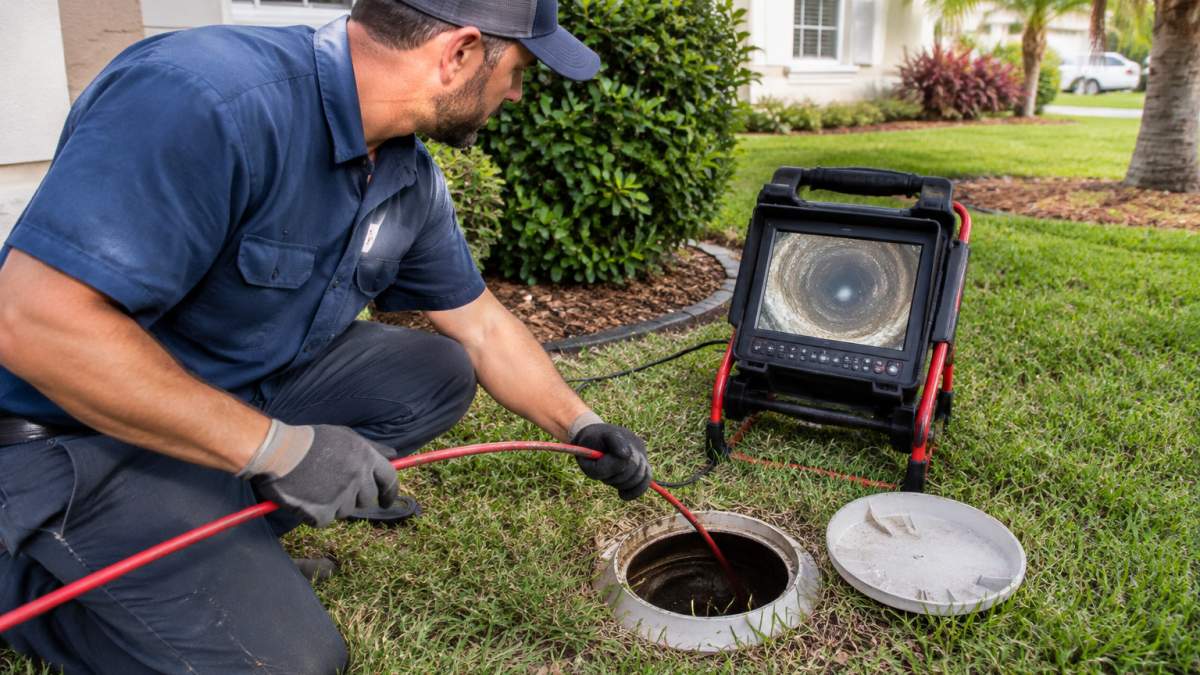
This step decides everything else. Without it, a no-dig repair is only a guess.
- Ask for a written report with video or photos of the problem spots.
- Note the location and depth of each defect.
- Compare the findings against the repair methods below.
CW Plumbing offers sewer camera inspections for residential and commercial properties in Pinellas Park. Our sewer camera inspection cost guide explains what the process reveals and how to apply for local rebates.
Step 2: Match Your Pipe Damage to the Right Method
Not every pipe can be fixed without digging. The damage type, pipe material, and alignment set the path. Use the guidance below as a decision framework, then confirm with your inspection report.
A simple decision path
Start with the inspection findings and work through these questions in order:
- Is the pipe still round and structurally sound? If yes, lining or a spot repair sleeve is usually the first option. If the pipe is deformed, collapsed, or crushed, lining cannot restore shape and you move to bursting or excavation.
- Is the defect localized or spread across the line? A single crack or joint leak may suit a short repair sleeve. Multiple defects or a long run of deterioration point to a full-length liner or replacement.
- Does the pipe hold grade? A belly or sag that traps water cannot be corrected by lining alone; bursting or excavation is typically needed to re-establish slope.
- How many access points are available? Lining often needs one cleanout and a small entry pit. Pipe bursting needs two access points, usually a cleanout and an exit pit. If no cleanout exists, one may need to be installed first.
- What is the pipe material? Clay, cast iron, PVC, and Orangeburg each behave differently. Orangeburg and badly deteriorated cast iron often cannot be lined reliably and may call for bursting or replacement.
Damage that suits no-dig repair
No-dig repair works best when the pipe is still in place and mostly round. Small cracks, joint leaks, and root-damaged sections are common candidates. Lining can cover these defects without disturbing the surrounding soil. In Pinellas Park, sandy soil and dense tree roots are common, and roots that have entered at joints can often be cleared and then sealed with a liner.
When excavation is still necessary
Some problems still require digging. A collapsed section, a pipe with a severe belly, or a line that runs under a structure may need a trench. Tree roots that have grown through a pipe wall and damaged it beyond repair also often call for excavation. A clear inspection report helps you spot these cases early.
Watch out: choosing a method before the camera inspection is complete can lead to a liner being installed over a defect it cannot fix, which means paying twice for the same line.
The right no-dig method depends on what the camera inspection finds, as summarised below.
| Damage or condition | Suggested method | Why |
|---|---|---|
| Pipe still round and sound | Lining or repair sleeve | Restores the pipe without disturbing soil |
| Collapsed or crushed pipe | Pipe bursting or excavation | Lining cannot restore the pipe’s shape |
| Belly or sag that holds water | Bursting or excavation | Lining alone cannot correct grade |
| Single crack or joint leak | Short repair sleeve | Targets one localized defect |
| Defects spread across the line | Full-length liner or replacement | A sleeve cannot span widespread damage |
| Orangeburg or badly deteriorated cast iron | Bursting or replacement | Lining often cannot be reliably installed |
Step 3: Check Florida Permits, Utility Locates, and Site Conditions
Sewer work in Florida involves more than the repair itself. Before any crew starts, check the following.
- Permits: Repairs on a sewer lateral may require a permit from the local building or utility authority. Ask your plumber who pulls it.
- Utility locates: Before any digging or bursting, underground utilities should be marked. Florida uses the Sunshine 811 system for locate requests.
- Site conditions: Sandy soil, a high water table, and dense tree roots are common in Pinellas Park. Each one changes how a repair is planned.
- Access points: A trenchless job needs a cleanout or an access pit. If your home lacks a cleanout, one may need to be installed first.
Trenchless Sewer Line Repair Cost and Estimate Comparison
Trenchless sewer line repair cost varies with pipe length, depth, the method chosen, and the amount of prep work. In the Pinellas Park area, most practitioners find that a spot repair sleeve is the least expensive option, a full-length liner costs more, and pipe bursting or excavation typically carries the highest cost because of the added access and replacement work. We do not publish set prices for this work because every line is different. Pricing depends on what the inspection finds.
What drives the price
- Length of the repair: A short sleeve covering a few feet costs far less than lining an entire lateral.
- Depth of the pipe: Deeper lines require more access work and shoring.
- Access conditions: A missing cleanout, a finished driveway, or landscaping over the line adds prep cost.
- Method and material: Liner material, pipe material for bursting, and the equipment needed all affect the total.
- Permit and utility locate fees: These are separate line items and should appear on every estimate.
Checklist for comparing written estimates
When you compare estimates, look at more than the total. Check that each one includes:
- The inspection and written report with video or photos
- Permit and utility locate fees
- Access point work, such as cleanout installation or small pit excavation
- The method, liner or pipe material, and expected lifespan
- Warranty terms and length
- Restoration of any disturbed surface, such as sod or pavement
- Whether the price is a fixed bid or an hourly plus materials estimate
A low estimate that leaves out the permit or the cleanout may cost more later. Ask each contractor to itemize the same scope so you can compare like with like.
For current pricing or a quote for your property, contact CW Plumbing directly or visit our website.
Sewer Pipe Repair Sleeve Options and Their Limits
A pipe repair sleeve is a short liner that covers one damaged section, such as a crack or a small joint leak. It is a targeted fix, not a full-line solution. Sleeves can be a good choice when damage is confined to a few feet of pipe.
Sleeves have limits. They do not correct a belly or a collapsed section, and they cannot span a long run of damage. If the inspection shows defects spread across the line, a full liner or replacement is usually the better path. Ask your plumber whether a sleeve fits your specific damage.
Booking Your Pinellas Park Sewer Inspection Next
If you think your sewer pipe may be damaged, start with a camera inspection. It tells you whether a no-dig repair is possible and what it will involve.
CW Plumbing is a locally owned business that serves Pinellas Park and the rest of Pinellas County. Our team handles sewer camera inspections and emergency service. Book a sewer inspection with CW Plumbing to find out what your pipe needs.
Hunting for a discount on your repair? Check our current special offers before you request a quote.
Frequently Asked Questions
Is it possible to replace a sewer line without digging?
In many cases, yes. Trenchless methods such as pipe lining (cured-in-place pipe) and pipe bursting can repair or replace a sewer line through existing access points, with small entry and exit pits instead of a full trench. Whether it works depends on the pipe material, its diameter, the location and severity of breaks or root intrusion, and the condition of the surrounding soil. A camera inspection is the only reliable way to confirm suitability. If the pipe has collapsed, is severely offset, or the route is blocked, excavation may still be required.
How much does trenchless sewer line repair cost?
Trenchless sewer line repair cost varies with pipe length, diameter, depth, access, and the method chosen, so no single price applies. Pricing depends on these factors and on the scope of the job. For a current quote for your property in Pinellas Park, contact CW Plumbing through its website. Ask any provider for an itemized estimate so you can compare the cost of the inspection, the repair method, and any excavation needed for access points.
How long does trenchless sewer repair last?
Lifespan depends on the method, the materials used, the installation quality, and the condition of the existing pipe. Cured-in-place liners are designed to provide a long service life when installed correctly, and pipe bursting replaces the old line with new pipe. Ask any provider about warranty terms in writing, and confirm what the warranty covers. Regular sewer maintenance and avoiding grease, wipes, and roots in the line help protect any repair.
What are the limitations of trenchless pipe lining?
Pipe lining cannot fix every problem. It generally needs a pipe that is still intact enough to hold the liner, and it reduces the internal diameter slightly. Severe bellies, major offsets, collapsed sections, or heavy root intrusion may need cleaning, spot repair, or excavation before lining. Sleeves are typically used for localized cracks or joint leaks rather than long runs of damage. A camera inspection helps identify which limitations apply to your line.
