


Book An
Appointment
Lorem ipsum dolor sit amet, consectetur adipiscing elit, sed do eiusmod tempor incididunt ut labore et
Our Services
Table of Contents
- What Makes 24-Hour Plumbing Service Pricing Opaque
- Understanding the 24-Hour Plumber Call-Out Fee
- Emergency Plumbing Estimate: What Should Be Included
- Key Questions to Ask an Emergency Plumber
- How to Compare Plumbing Quotes Effectively
- Red Flags That Indicate Hidden Pricing Practices
- Protecting Yourself With Written Estimates and Authorization
- Frequently Asked Questions
Last Updated: October 12, 2026
What Makes 24-Hour Plumbing Service Pricing Opaque
When a pipe bursts at midnight, you’re not in a position to negotiate.
A daytime faucet repair has predictable labor and parts costs. A 2 a.m. burst pipe involves after-hours premiums, emergency surcharges, and diagnostic uncertainty until the plumber assesses the damage.
Most emergency plumbers build pricing around three layers: a base service-call fee, a higher-than-standard hourly rate, and parts markup.
Understanding the 24-Hour Plumber Call-Out Fee
A 24-hour plumber call-out fee is the fixed charge for sending a technician to your home, whether the repair takes 15 minutes or three hours.
The call-out fee covers travel time, vehicle overhead, and the opportunity cost of being away from other jobs.
A standard daytime call-out fee covers the dispatch; after-hours adds a premium, and weekends and holidays stack higher.
Emergency Plumbing Estimate: What Should Be Included
A proper emergency plumbing estimate breaks down every cost component so you can decide before work begins. The test: can you add up the numbers yourself? Here is a fully itemized sample to hold any quote against.
The components every estimate should name
- Service-call or dispatch fee: The fixed charge for arrival, listed separately with the specific time-of-day rate applied
- Diagnostic fee (if applicable): Some providers charge to identify the problem; others roll this into labor
- Estimated labor hours: The plumber’s best guess at how long the repair will take, multiplied by the hourly rate for that time period
- Estimated parts and materials: Specific pipe fittings, valves, or replacement components with individual costs listed
- After-hours premium or surcharge: The percentage markup or additional hourly rate applied outside standard business hours
- Minimum charge: The lowest amount you’ll pay even if work takes less time than estimated
- Sales tax on parts and, in some states, on labor: Whether tax applies to labor varies by jurisdiction, so the estimate should state it
- Payment terms: Whether the estimate is binding, what happens if costs exceed it, and what payment methods are accepted
A sample itemized estimate (2 a.m. burst supply line)
Here is how a transparent provider might write up a middle-of-the-night call for a burst 3/4-inch copper supply line behind a kitchen wall. Figures are illustrative, but the structure matters:
| Line item | Detail | Amount |
|---|---|---|
| Dispatch / call-out fee (after-hours) | Flat arrival charge, 11 p.m.-6 a.m. window | $95 |
| Diagnostic fee | Applied toward labor if repair is authorized | $0 (credited) |
| Labor, first hour | After-hours rate, 1-hour minimum | $185 |
| Labor, additional 0.5 hour | Same after-hours rate, billed in 15-min increments | $92.50 |
| Parts, 10 ft 3/4″ copper pipe | Per-foot price × 10 | $48 |
| Parts, fittings, couplings, solder | Itemized individually | $22 |
| Parts, shutoff valve | 3/4″ ball valve | $18 |
| After-hours premium | Already embedded in the $185/hr rate above | $0 (disclosed) |
| Sales tax | Applied to parts only in this example | $6.16 |
| Estimated total | $466.66 |
- The after-hours premium is disclosed as embedded, not stacked. Some providers advertise a “standard” rate, then add a 50% night premium on top; others quote the after-hours rate directly. Either is fine, hiding which one you use is not.
- The diagnostic fee is credited. A common opaque practice is charging a $99-$150 diagnostic fee and a full labor rate. A transparent provider credits it toward the repair or states clearly that it’s separate and non-refundable.
- Parts are priced per unit. “Parts: $88” tells you nothing. “10 ft of 3/4-inch copper at $4.80/ft, plus $22 in fittings” lets you sanity-check the markup.
- Tax is called out. If your state taxes labor (some do, some don’t), the estimate should say so rather than surprising you at the invoice.
What a vague estimate looks like by comparison
An opaque provider’s version often reads: “Burst pipe repair, approximately $400 to $900, depending on what we find.” That range covers almost any final bill and commits the provider to nothing. Authorize work on that basis and you’ve agreed to pay whatever the plumber decides the job was worth.
A range quote is not an estimate. If the spread between the low and high number is more than about 30-40% of the low end, ask the plumber to narrow it before you authorize work, or get a second quote.
Firm quote vs. estimate subject to change
The estimate should clarify whether it’s a firm quote or subject to change. If the plumber finds additional damage, corroded pipe, a failed shutoff valve, water damage, will they contact you first, or just add it to the bill? A transparent estimate answers in writing: “Any work beyond the scope above requires written or verbal approval from the customer before it is performed.”
If that sentence is missing, ask for it. It is the single most important line in the document.
Key Questions to Ask an Emergency Plumber
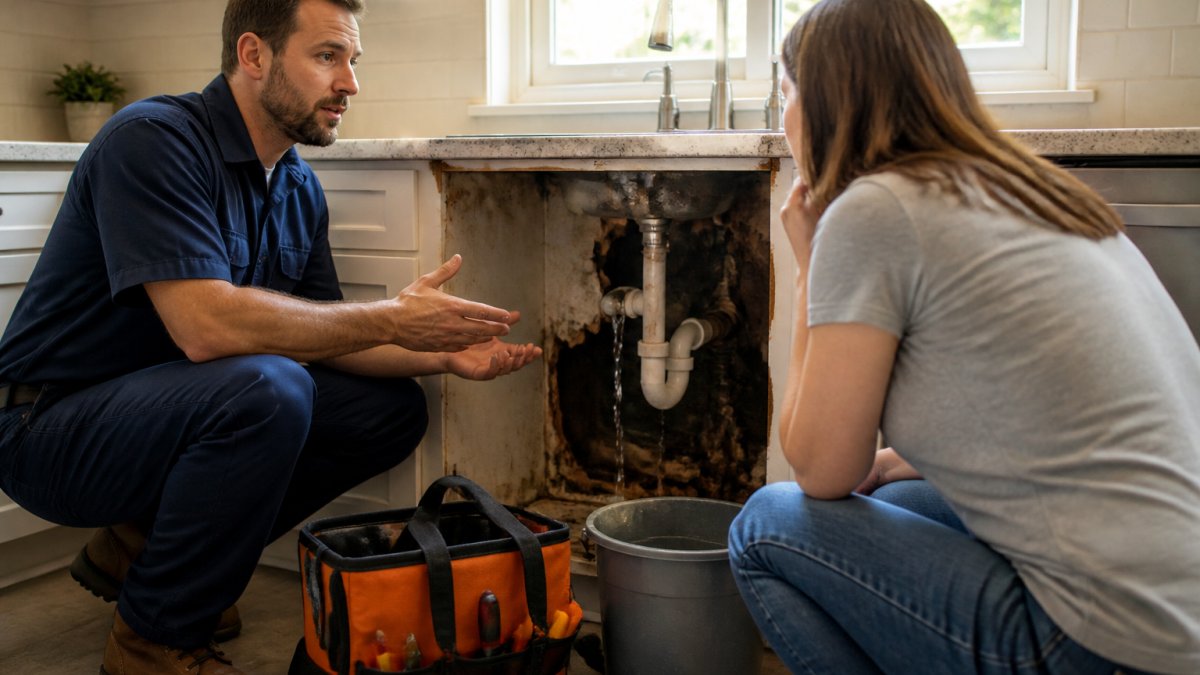
Before authorizing emergency work, ask these questions to expose pricing practices and avoid unexpected charges.
-
What is your exact call-out fee for this time of day? Don’t accept “it depends” or “we’ll include it in labor.” Demand a specific number.
-
Is your quoted hourly rate different after hours or on weekends? If yes, what is the exact rate for the time you’ll be here?
-
Do you charge a diagnostic fee separate from labor? Some plumbers charge $100-150 just to identify the problem, then charge again for the fix.
-
What is your minimum charge? Many emergency plumbers have a one-hour minimum even if the repair takes 20 minutes.
-
Will you provide a written estimate before starting work? If they refuse, that’s a red flag. Written estimates protect both parties.
-
What happens if the repair costs more than the estimate? Will you contact me for approval before exceeding the estimate, or will you just add charges?
-
Are parts marked up, and if so, by how much? A 50% markup is reasonable; 150% is not. Ask for clarity.
-
Do you offer any guarantees on the work? If a repair fails within 30 days, will you return at no charge?
-
What payment methods do you accept? Some emergency plumbers demand cash or check only, limiting your ability to dispute charges.
-
Can you provide references or recent customer reviews? Transparent pricing correlates with positive customer feedback.
These questions extract the information you need and signal that you won’t accept vague billing.
How to Compare Plumbing Quotes Effectively
Comparing quotes for the same emergency repair requires looking beyond the headline price, the lowest total often masks hidden charges or incomplete scope.
The fastest way to compare quotes is to run the same job past two providers and see which gives you a document you can audit. Here is a side-by-side for the identical 2 a.m. burst-pipe job:
| What you asked | Transparent provider says | Opaque provider says |
|---|---|---|
| “What’s your call-out fee tonight?” | “$95 flat, 11 p.m.-6 a.m.” | “We’ll work it into the labor.” |
| “What’s your hourly rate after hours?” | “$185/hr, 1-hour minimum, 15-min increments after.” | “Around $150 to $200, depends.” |
| “Is there a diagnostic fee?” | “$0, credited toward the repair if you authorize it.” | “$99, non-refundable.” |
| “Can you send a written estimate?” | “Yes, emailed before we start.” | “We don’t do that for emergencies.” |
| “What if you find more damage?” | “We call you for approval before doing anything extra.” | “We’ll just fix it and let you know.” |
| “What’s the total, all-in?” | “$466.66, itemized.” | “Probably $400 to $900.” |
Same job, same night, two experiences: the transparent column gives you a number you can hold the provider to; the opaque column gives you a range you can’t dispute.
Build your own comparison table
When you have two or three quotes in hand, drop them into a table like this so the differences are visible:
| Cost Component | Provider A | Provider B | Provider C |
|---|---|---|---|
| Call-out fee | $75 | $95 | $60 |
| Hourly rate (after-hours) | $150 | $175 | $140 |
| Estimated labor hours | 2 | 1.5 | 2.5 |
| Estimated parts | $200 | $180 | $250 |
| Minimum charge | 1 hour | 2 hours | 1 hour |
| Diagnostic fee | $0 | $99 | $0 |
| Estimated total | $575 | $532.50 | $600 |
This reveals what you’re actually paying for. Provider B looks cheapest, but their 2-hour minimum and $99 diagnostic fee raise the real floor if the job finishes fast. Provider C’s higher parts estimate may reflect a more thorough repair.
Three tests that separate transparent from opaque
- The specificity test. Can the provider give you a dollar figure, or only a range? A range wider than about 30-40% of the low end is a signal that the provider is preserving room to charge more.
- The documentation test. Will they put it in writing before the truck rolls? A provider who refuses written estimates for emergencies is telling you they want the flexibility to change the number later.
- The change-order test. Ask directly: “If you find something else wrong, do you call me first?” The right answer is yes, every time. The wrong answer, “we’ll just handle it”, means you have authorized an open-ended bill.
Compare scope, not just price
Also compare scope. Do all three quotes include the same repair, or is one a temporary fix while another replaces the entire section of pipe? The cheapest quote might solve the crisis but leave you vulnerable to another failure in weeks. When quotes differ by more than about 25% on the same job, the difference is almost always scope or parts quality, so ask each provider exactly what they’ll replace and with what material.
The lowest headline number is rarely the lowest final bill. The provider who can hand you a specific, itemized, written number before starting work is almost always the one who will charge you what they said.
Red Flags That Indicate Hidden Pricing Practices
Certain behaviors signal a plumber likely to surprise you with unexpected charges.
Refusal to break down costs. “It’s just $X total” with no details means they’re hiding something. Every cost should be transparent.
Unwillingness to provide references or reviews. Transparent providers have nothing to hide and readily share recent customers’ contact information.
Refusing to provide a warranty or guarantee on work. A plumber who won’t stand behind their repair likely cut corners.
Protecting Yourself With Written Estimates and Authorization
Before signing any estimate, verify these elements:
Scope of work is specific. “Fix the leak” is not specific. “Replace the 3/4-inch copper supply line from the main shutoff to the kitchen sink with new copper pipe and fittings” is.
Payment terms are clear. When is payment due?
Warranty or guarantee is stated. How long does the plumber guarantee their work?
Once signed, keep a copy and refer to it throughout the repair.
Many homeowners hesitate to ask for written estimates during emergencies, fearing delay. A professional plumber can provide one in minutes.
Emergency plumbing puts you in a vulnerable position, but it doesn’t have to leave you blindsided by charges.
Frequently Asked Questions
What does a plumber typically charge for after-hours emergency service?
After-hours emergency plumbing rates vary by provider and location, but most charge a premium above standard hourly rates, often time-and-a-half or double-time for nights, weekends, and holidays. Many also add a separate emergency service fee or dispatch charge on top of labor. Always ask upfront what the total after-hours rate will be, including any surcharges, before authorizing work. Transparent providers will quote the complete cost structure before they begin.
Do 24-hour plumbers charge a call-out fee, and is it separate from labor?
Yes, most 24-hour plumbers charge a separate call-out or dispatch fee to send a technician to your home. This fee typically ranges from $50 to $150 and is often applied even if the plumber cannot fix the issue on the first visit. Some providers credit this fee toward the final bill if work is completed; others do not. Transparent pricing means the call-out fee is disclosed before dispatch, not hidden in the final invoice.
Should an emergency plumber provide a written estimate before starting work?
Yes. A reputable emergency plumber should provide a written estimate or quote that outlines the diagnostic fee, labor costs, parts, and any additional charges before beginning repair work. This protects you from unexpected bills and gives you the chance to ask questions or seek a second opinion. If a plumber refuses to provide an estimate upfront or pressures you to authorize work without one, that’s a warning sign of opaque pricing practices.
What is the best way to compare emergency plumbing quotes from different providers?
Request itemized written estimates from at least two providers that break down diagnostic fees, hourly labor rates, parts costs, and any surcharges separately. Ask each provider the same questions about their after-hours rates, call-out fees, and minimum charges so you can compare apples to apples. Check whether estimates include a warranty on parts and labor, and confirm the total cost ceiling before work begins. This structured approach reveals which providers practice transparent pricing.