


Book An
Appointment
Lorem ipsum dolor sit amet, consectetur adipiscing elit, sed do eiusmod tempor incididunt ut labore et
Our Services
Table of Contents
- Why Hiring Licensed Plumbing Contractors Protects Your Home and Wallet
- Licensed vs. Unlicensed Plumber: What the Difference Really Means
- How to Verify a Plumbing Contractor License Before You Sign
- Insurance, Liability, and What Happens When Something Goes Wrong
- Questions to Ask a Plumbing Contractor Before Hiring
- Commercial Plumbing Maintenance for Small Businesses: Why Licensing Matters
- How Licensing Affects Cost, Quality, and Long-Term Value
- Conclusion: Making the Right Call for Your Plumbing Project
- Frequently Asked Questions
Last Updated: October 14, 2026
Why Hiring Licensed Plumbing Contractors Protects Your Home and Wallet
Hiring licensed plumbing contractors is the most reliable way to protect your home, your wallet, and your legal standing. A license proves a plumber passed state exams, carries insurance, and answers to a regulatory board.
Licensed plumbing contractors have met their state’s training, examination, and insurance requirements and hold a current credential, the difference between a repair that holds and one that floods your kitchen three weeks later.
A plumbing license is your only built-in recourse if a job goes wrong. Without it, your options shrink to small claims court and a lot of luck.
What Licensing Does and Does Not Guarantee
Licensing guarantees three things: verified training, passing an exam, and a minimum level of insurance. It does not guarantee the lowest price, the fastest turnaround, or that every technician sent to your door is equally skilled.
What it does guarantee matters more.
What licensing does not cover is the quality gap between two licensed contractors. One may specialize in water heaters, another in sewer lines. Ask what they do most before assuming the license covers everything.
Licensed vs. Unlicensed Plumber: What the Difference Really Means
The practical difference between a licensed and an unlicensed plumber comes down to three things: legal permission to pull permits, insurance coverage, and accountability when something breaks.
Unlicensed work also creates a liability trap. If an unlicensed contractor is injured in your home, your homeowner’s insurance may deny the claim. If their work causes a fire or flood, your insurer can refuse to cover the damage because the work was not permitted or inspected.
Building codes in most jurisdictions require permits for water heater replacements, sewer line work, gas line changes, and major remodels. A licensed contractor pulls those permits and schedules the inspections; an unlicensed one usually asks you to skip them.
If you hire an unlicensed contractor and the work fails inspection, you may be required to tear out and redo the entire job at your own expense. Some municipalities also fine the homeowner, not the contractor.
How to Verify a Plumbing Contractor License Before You Sign
Verifying a plumbing contractor license takes about five minutes and is the highest-value step in the hiring process. Every state maintains a public license lookup, usually through the board that regulates contractors or plumbing.
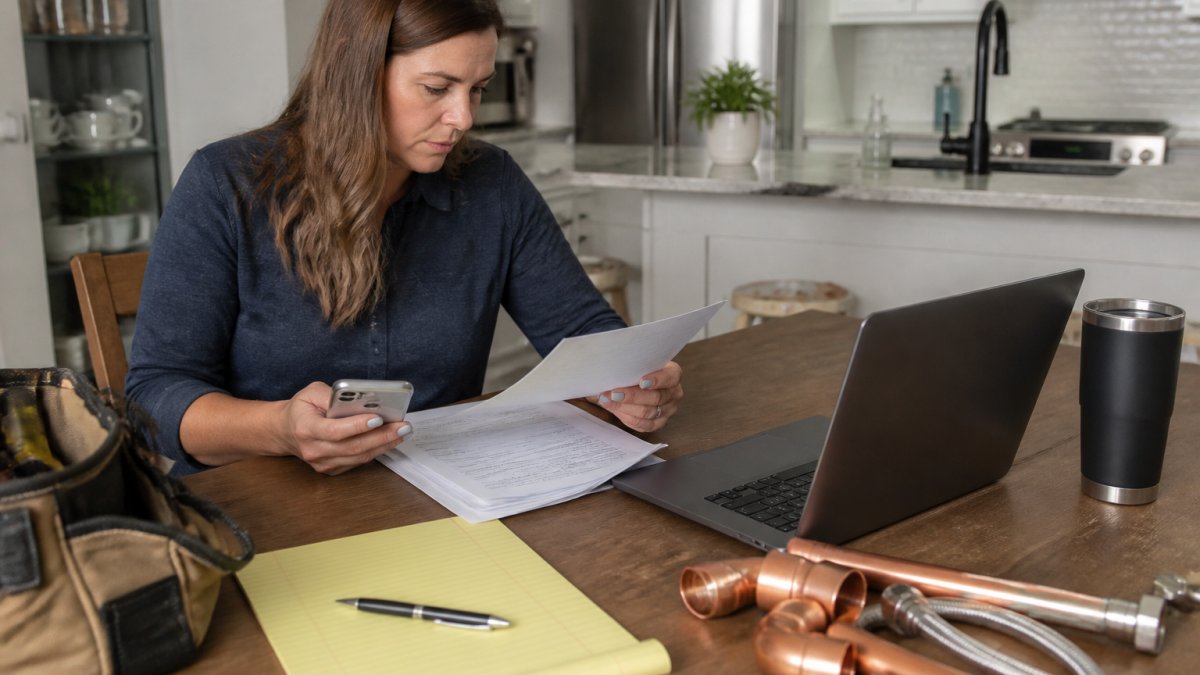
Here is the process we recommend:
- Ask for the license number in writing before any work begins. A legitimate contractor provides it without hesitation.
- Look up the number on your state’s licensing board website. Confirm the status reads “active,” not “expired” or “suspended.”
- Check the license classification. Some licenses cover residential only, others cover commercial or specialty work like gas lines.
- Request a certificate of insurance and call the insurer to confirm the policy is current. Do not accept a photocopy alone.
- Search for complaints or disciplinary actions on the same board site. One complaint may be an outlier; a pattern is a red flag.
- Confirm the license matches the business name on the contract. Some contractors work under a different legal entity than the one they advertise.
As documented in state contractor licensing guidance from the Florida Department of Business and Professional Regulation, license status, complaint history, and insurance filings are all public record. Use them.
Insurance, Liability, and What Happens When Something Goes Wrong
Insurance is where the licensed versus unlicensed gap becomes expensive. A licensed plumbing contractor typically carries general liability insurance, which pays for damage to your property, and workers’ compensation, which covers crew injuries on your property.
Without those policies, you absorb the risk. If an unlicensed worker falls off a ladder in your bathroom, your homeowner’s policy may deny the medical claim.
Liability protection works in two directions: it protects you from the contractor’s mistakes and the contractor from unfair claims.
A common mistake is assuming a contractor’s “insurance” covers everything. Ask specifically for a certificate naming general liability and workers’ compensation, and verify the effective dates cover your project window.
Questions to Ask a Plumbing Contractor Before Hiring
The right questions before hiring a plumbing contractor separate professionals from pretenders in about ten minutes. Ask them in person or on the phone, and note how quickly and directly they answer.
- Are you licensed, and what is your license number? A professional answers immediately.
- Are you insured, and can you provide a certificate? Ask for general liability and workers’ compensation.
- Will you pull the required permits? If the answer is “you don’t need a permit for this,” get a second opinion.
- Who will actually do the work? Some contractors subcontract. Ask who shows up and whether they are licensed too.
- What is your warranty on parts and labor? A written warranty is a sign of confidence in the work.
- How do you handle unexpected problems found mid-job? Ask for the process in writing before work starts.
- Can you provide references for similar jobs? Recent references for the same type of work matter most.
If a contractor dodges the license or insurance question, that is your answer. Move on.
Ask for the license number and insurance certificate by email before the estimate visit. Contractors who send them within an hour are almost always the ones you want to hire.
Commercial Plumbing Maintenance for Small Businesses: Why Licensing Matters
Commercial plumbing maintenance raises the stakes of the licensing question because the consequences of unlicensed work scale with the building.
What makes commercial work different is the regulatory layer on top of it. Commercial systems typically fall under stricter code requirements than residential systems, and the rules vary by building type, occupancy, and jurisdiction. Three areas come up most often:
- Backflow prevention. Many jurisdictions require annual testing of backflow prevention assemblies on commercial water lines, and the test must be performed by a certified tester and filed with the local water authority. An unlicensed contractor cannot legally perform or certify that test.
- Grease interception. Food service establishments are usually required to maintain grease traps or interceptors sized to their fixture load, with documentation of pumping and disposal. A plumber who does not know the local pretreatment rules can leave a restaurant out of compliance without the owner realizing it.
- Gas and commercial appliance connections. Commercial kitchen equipment, rooftop units, and boiler systems often require permits and inspections that residential plumbers never touch. The license classification that covers this work is frequently separate from a general plumbing license.
Small commercial property owners often assume they are too small to need a licensed contractor. The opposite is usually true. A single-unit retail space still has a water service, a sewer lateral, and often a backflow assembly, each with its own inspection and documentation requirements.
For property managers, licensing also simplifies coordination. A licensed contractor can pull permits, schedule inspections, and produce the documentation a landlord, lender, or insurer requires, often the difference between a covered claim and an uncovered one.
If you manage commercial property, ask your plumber for the license classification that covers backflow testing and gas work specifically. A general plumbing license does not always include those endorsements.
The takeaway is the same as for a home: licensing is not a formality, it is the mechanism that keeps a commercial system legal, insurable, and inspectable. The scale of the building only widens the gap between licensed and unlicensed work.
How Licensing Affects Cost, Quality, and Long-Term Value
Licensing affects cost in ways that do not show up on the initial quote, which is why comparing two estimates side by side can be misleading. A licensed contractor often charges more upfront because the price includes insurance premiums, permit fees, inspection scheduling, and trained labor.
The honest way to compare is to add up every cost that can follow a plumbing job, not just the invoice. The difference shows up in four places:
- Permit and inspection fees. A permitted job includes a fee paid to the jurisdiction and one or more inspections. An unlicensed contractor who skips the permit saves that fee, but the homeowner inherits the risk. If the work is later discovered during a sale, a refinance, or an insurance claim, the permit has to be pulled retroactively, often at a higher cost, and the work may have to be opened up for inspection.
- Rework and correction. When unpermitted work fails inspection, the correction is usually paid by the property owner, not the original contractor. That means paying twice: once for the original job and once for the fix. The correction can also require tearing out finished surfaces, which adds labor and materials that were never in the first quote.
- Water damage and secondary repairs. A slow leak behind a wall can run for weeks before it is noticed. By the time it is found, the repair often includes drywall, insulation, flooring, and sometimes mold remediation. Those costs are rarely covered when the underlying work was unpermitted, because the insurer can point to the unpermitted work as the cause.
- Disclosure and resale. Many jurisdictions require sellers to disclose known unpermitted work. A buyer’s inspector who finds unpermitted plumbing can demand a price reduction, a repair credit, or a walk-away. That is a cost that shows up years after the original invoice was paid.
| Factor | Licensed Contractor | Unlicensed Contractor |
|---|---|---|
| Upfront quote | Higher | Lower |
| Permit and inspection fees | Included in quote | Usually skipped |
| Insurance coverage | General liability and workers’ comp | Usually none |
| Warranty | Written, enforceable | Rare or verbal |
| Rework risk | Low | High |
| Secondary damage exposure | Covered by contractor’s policy | Borne by homeowner |
| Resale disclosure | Clean record | Potential issue |
| Recourse if something fails | Licensing board, bond, insurer | Small claims court |
The table is not an argument that licensed work is always cheaper. It is an argument that the two quotes are not measuring the same thing.
Repair costs also vary widely. A water heater replacement, a sewer line repair, and a slab leak have very different cost structures, and none can be compared meaningfully without a written scope.
Conclusion: Making the Right Call for Your Plumbing Project
Choosing between a licensed and unlicensed contractor is not a close call. The licensed option protects your home, your insurance coverage, and your legal standing, and usually costs less over the life of the repair. The unlicensed option saves money upfront and creates risk you may not see for months.
If you are facing a plumbing repair, a remodel, or ongoing maintenance for a commercial property, start with a licensed contractor who can show you the credentials. CW Plumbing is a family and locally owned business serving residential and commercial clients, with emergency service available and advanced equipment for hydro jetting and sewer camera inspections. We handle everything from minor repairs to major installations.
Frequently Asked Questions
Can an unlicensed plumber legally perform plumbing work?
No. Every state requires a license for plumbing work, and performing it without one is illegal. Unlicensed work often fails inspection, which means you may have to pay twice: once for the bad job and again to fix it. It can also void your homeowner’s insurance and leave you liable for injuries or property damage. Always verify a plumber’s license before any work begins.
What should a business check before hiring a plumbing contractor?
Business owners should verify the contractor’s license status, insurance coverage, and whether they have experience with commercial systems. Ask for references from similar-sized businesses, confirm they can handle after-hours emergencies, and get a written scope of work with a clear schedule. A licensed plumbing contractor will provide all of this without hesitation and can coordinate permits and inspections for commercial projects.
Does hiring a licensed plumber protect a business from liability?
Yes. Licensed plumbing contractors carry general liability and workers’ compensation insurance, which shields your business from claims if a worker is injured or property is damaged on your premises. If an unlicensed worker gets hurt, your business could be held responsible. Licensed contractors also pull the required permits and schedule inspections, reducing the risk of code violations and fines that fall on the property owner.
How can a business verify a plumbing contractor’s license?
Start with your state or local licensing board’s online database. Search by the contractor’s name or license number and confirm the status is active and in good standing. Then ask the contractor for a copy of their license and insurance certificates, and call the insurance company to confirm coverage is current. Cross-check the business name and address to make sure everything matches.