


Book An
Appointment
Lorem ipsum dolor sit amet, consectetur adipiscing elit, sed do eiusmod tempor incididunt ut labore et
Our Services
Table of Contents
- Tankless vs. Tank Water Heaters: The Core Trade-Off
- Tankless Water Heater Sizing for Large Families
- Can a Tankless Water Heater Run Two Showers Simultaneously?
- Tankless Water Heater Cost to Install and Long-Term Expenses
- Tankless Water Heater Lifespan and Maintenance Requirements
- Real-World Performance Scenarios for Households of Five or More
- Is a Tankless Water Heater Worth It for Your Family?
- Frequently Asked Questions
Last Updated: October 17, 2026
Tankless vs. Tank Water Heaters: The Core Trade-Off
A tankless water heater heats water on demand without a storage tank, while tank water heaters keep a large reservoir hot continuously, a distinction that matters significantly for tankless water heater large families evaluating their options.
For a large family, this trade-off matters more: when multiple people shower, run the dishwasher, and do laundry at once, the heater must deliver enough hot water fast enough.
We help homeowners evaluate this using real household scenarios rather than marketing claims. Both systems can work for large families, it depends on whether you’ll accept tankless performance limits or prefer a tank’s guaranteed availability.
Tankless Water Heater Sizing for Large Families
Proper sizing is the single biggest factor determining whether a tankless water heater works for your household. Too small a unit struggles at peak demand; an oversized one wastes money. Here’s a worksheet you can actually use.
Step 1: List your fixtures and their flow rates
Flow rate is expressed in gallons per minute (GPM). Typical fixture flow rates in U.S. homes are:
| Fixture | Typical flow rate |
|---|---|
| Standard showerhead | 2.5 GPM |
| Low-flow showerhead | 1.5-2.0 GPM |
| Bathroom sink faucet | 1.0-1.5 GPM |
| Kitchen sink faucet | 1.5-2.0 GPM |
| Dishwasher | 1.5-2.0 GPM |
| Washing machine | 2.0-2.5 GPM |
| Bathtub faucet | 4.0-7.0 GPM |
Use the actual ratings printed on your fixtures where possible, low-flow fixtures cut peak demand substantially.
Step 2: Total your realistic simultaneous demand
Do not add every fixture in the house. Add the fixtures you actually run at the same time during your busiest 15-20 minutes. For a family of five, a realistic peak might be:
- Two showers at 2.5 GPM each = 5.0 GPM
- One bathroom sink at 1.5 GPM = 1.5 GPM
- Peak demand = 6.5 GPM
If someone starts the dishwasher during that window, add 2.0 GPM for a peak of 8.5 GPM. If laundry starts too, add another 2.0-2.5 GPM, the same family can land anywhere from 6.5 to 11 GPM depending on routine.
Step 3: Account for temperature rise and cold incoming water
This step matters most for large families in cold climates. A tankless unit’s capacity is rated at a specific temperature rise, the difference between incoming and desired hot-water temperature.
Manufacturers publish capacity curves showing GPM at different temperature rises. A unit rated 8 GPM at a 35°F rise delivers noticeably less at a 70°F rise, because the heat exchanger has a maximum BTU input.
Incoming water varies by region and season: northern states see 40s°F in winter, southern states stay in the 60s-70s°F year-round.
Sizing to the summer number is the most common large-family mistake. Always size to your coldest realistic incoming water temperature, or you will get cold showers in January.
Step 4: Match the unit to your worst-case peak
Take your peak demand from Step 2 and find the unit’s rated GPM at your winter rise from Step 3. A 6.5 GPM winter peak at a 65°F rise needs a unit delivering at least 6.5 GPM at that rise, not its headline GPM at a smaller rise.
If your worst-case peak exceeds what a single unit can deliver at your winter rise, you have three options: reduce simultaneous demand by staggering routines, install a larger commercial-grade unit, or install two units in parallel with dedicated zones (for example, one for bathrooms and one for kitchen and laundry).
A worked example for a family of five
- Fixtures: two showers (5.0 GPM), one bathroom sink (1.5 GPM), dishwasher (2.0 GPM) = 8.5 GPM peak.
- Winter incoming water: 45°F. Desired output: 110°F. Temperature rise = 65°F.
- Required capacity: at least 8.5 GPM at a 65°F rise, plus margin → target roughly 9.5-10 GPM at that rise.
Household size alone is a poor sizing shortcut: two families of five can differ by 3-4 GPM in peak demand depending on fixtures and routine, making the same unit adequate in one home and undersized in the other.
Can a Tankless Water Heater Run Two Showers Simultaneously?
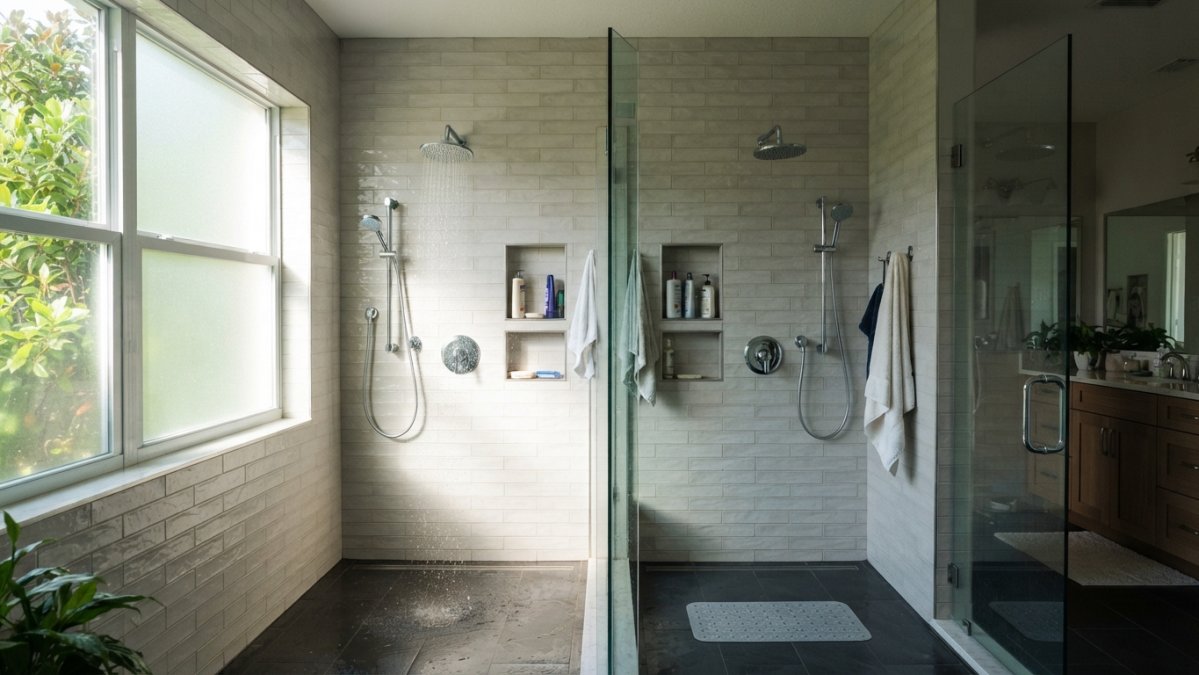
Yes, but only if the unit is sized for it.
Two showers typically demand 5 GPM total (2.5 GPM each), which a properly sized 6-7 GPM unit handles comfortably.
The real limitation emerges with a third simultaneous load.
Some families install multiple tankless units in parallel, one for bathrooms, one for kitchen appliances. It costs more upfront but eliminates the simultaneous demand problem.
Tankless Water Heater Cost to Install and Long-Term Expenses
For a large family, the real question is which system costs less over the 15-20 years you own it. The answer depends on fuel type, utility rates, installation complexity, and actual hot-water use. Here’s a framework you can plug your own numbers into.
Upfront cost: what drives the spread
Installation cost is equipment plus the retrofit work your home requires. The biggest drivers:
- Fuel type. Gas-fired tankless units generally cost more to install than electric models because they require Category III stainless venting (or concentric venting), a properly sized gas line, and often a larger meter or regulator. Electric tankless units avoid venting but may require a dedicated 120-amp or higher electrical service and multiple circuits, which can trigger a panel upgrade.
- Retrofit versus new construction. Replacing an existing tank in the same location is usually the cheapest path because the water lines, gas line, and electrical are already roughed in. Moving the unit to a different wall, garage, or exterior closet adds plumbing and venting labor.
- Venting route. A short horizontal vent through a sidewall is cheaper than a long vertical run through the roof. Condensing units also need a condensate drain, which may require a neutralizer and a route to a drain.
Because these variables swing widely, a credible quote requires an on-site evaluation. For a detailed quote specific to your home and situation, contact a licensed plumber who can assess your setup.
Operating cost: the fuel math that actually matters
The operating-cost advantage of tankless comes from eliminating standby losses, the energy a tank spends keeping 40-80 gallons hot 24/7. Its size depends on three variables:
- How much hot water you use. A large family uses more hot water, so the standby loss is a smaller share of total energy use. That actually narrows the tankless advantage compared with a low-use household.
- Fuel type and utility rates. Natural gas is usually cheaper per delivered BTU than electricity in most markets, so a gas tankless unit typically shows a clearer operating-cost advantage than an electric one. Electric tankless units can be expensive to operate in high-electricity-rate areas.
- Standby loss of the tank you are replacing. Older tanks with worn insulation lose more heat than new ones, so the savings from switching are larger when replacing an old, inefficient tank.
A gas tankless unit typically saves roughly 10-20% on water-heating energy versus a comparable new tank, and more versus an old one. If you spend $600 a year heating water, 15% is about $90 a year, real money, but not enough to quickly repay a multi-thousand-dollar installation premium.
Maintenance and repair: the costs competitors gloss over
Tankless units are not maintenance-free. In hard-water areas, annual descaling protects the heat exchanger; skipping it shortens equipment life and can void the warranty. Tank systems need less routine service but are more prone to reactive repairs, leaking tanks, failed elements, and tank failure often means emergency replacement.
Tankless repairs cost more per incident because components are pricier, but tankless units have fewer failure points and a longer service life when maintained.
Lifetime cost comparison: three example households
Here is a framework using transparent assumptions. Plug in your own quotes and utility rates.
| Cost category | Tank system (example) | Tankless system (example) |
|---|---|---|
| Equipment + installation | Lower upfront | Higher upfront (venting, gas line, condensate) |
| Annual energy | Higher (standby losses) | Lower (on-demand heating) |
| Annual maintenance | Minimal routine | Annual descaling in hard water |
| Repair profile | Fewer, cheaper incidents; tank failure risk | Fewer failure points; higher cost per repair |
| Expected service life | 8-12 years | 15-20 years with maintenance |
| Replacement cycles over 20 years | ~2 tanks | ~1 tankless unit |
Scenario A: Family of five, gas heat, moderate use, planning to stay 15+ years. The tankless operating savings plus one avoided tank replacement often narrows or closes the lifetime gap.
Scenario B: Family of five, electric heat, high electricity rates, planning to move in 5 years. The operating savings are smaller and the payback period extends beyond the planned ownership window.
The honest answer is that tankless rarely wins on upfront cost and only sometimes wins on lifetime cost. It wins most clearly when you have gas heat, moderate-to-high hot-water use, hard water you are willing to maintain for, and a long ownership horizon. Get itemized quotes for both options in your home before deciding, the installation variables, not the marketing claims, usually determine the answer.
Tankless Water Heater Lifespan and Maintenance Requirements
A tankless water heater typically lasts 15-20 years with proper maintenance; a traditional tank system lasts 8-12.
The main maintenance requirement is annual descaling: hard water causes mineral buildup inside the heat exchanger, reducing efficiency and eventually causing failure.
For a large family in a hard-water area, budget for annual descaling, a routine, inexpensive service you must keep up to maintain lifespan and efficiency.
Real-World Performance Scenarios for Households of Five or More
Consider three common scenarios for a family of five:
Scenario 1: Staggered morning routine. One person showers at 7 a.m., another at 7:15 a.m., and a third at 7:30 a.m. Each shower runs 10 minutes. A tankless unit handles this easily because showers don’t overlap. Peak demand is a single shower at 2.5 GPM, well within the capacity of any residential unit.
Scenario 2: Overlapping morning showers and appliances. Two people shower simultaneously while someone starts the dishwasher. Peak demand is 6.5 GPM.
Scenario 3: Heavy simultaneous demand. Two showers running, dishwasher running, and laundry starting. Peak demand is 8.5 GPM. Most standard tankless units can’t sustain this without reducing temperature or flow.
Most large families experience Scenario 2 regularly and Scenario 3 occasionally.
Is a Tankless Water Heater Worth It for Your Family?
If your family regularly needs hot water from three or more fixtures simultaneously, a tank system or dual tankless units are more practical. In very cold winter climates, the temperature rise limitation of tankless systems becomes more pronounced.
The financial case for tankless is strongest when you plan to stay in your home for 10+ years and your household’s hot-water usage is substantial.
| Scenario | Best Option | Why |
|---|---|---|
| Two showers + occasional dishwasher | Tankless (7-8 GPM) | Handles typical demand; energy efficient |
| Two showers + dishwasher + laundry simultaneously | Dual tankless or tank system | Single tankless unit insufficient for peak demand |
| Very cold incoming water temperature | Tank system | Temperature rise limitation reduces tankless effectiveness |
| High hot-water usage, 10+ year timeline | Tankless | Lower operating costs offset higher installation cost |
| Planning to move within 5 years | Tank system | Lower upfront cost, shorter payback period |
For large families, the decision comes down to your actual usage patterns and willingness to accept performance trade-offs. A properly sized tankless water heater delivers reliable hot water and lower operating costs for most large families, but oversizing or installing two units can eliminate the financial advantage, right-sizing from the start is critical. Book an appointment with our team to evaluate your home and get a professional recommendation tailored to your family’s needs.
Frequently Asked Questions
What size tankless water heater do I need for a family of five?
A family of five typically needs a unit with a flow rate of 8-10 gallons per minute (GPM) and a temperature rise of 50-70°F, depending on incoming water temperature and simultaneous demand. If multiple showers or appliances run together, you may need a larger unit or two units installed in parallel. The exact size depends on your household’s peak demand, the number of fixtures used at once and how much hot water each requires. Professional sizing accounts for your incoming water temperature, which varies seasonally.
Can a tankless water heater handle two showers running at the same time?
A single tankless unit can struggle with two simultaneous showers in large households. Most standard units deliver 5-8 GPM, and two showers typically use 4-6 GPM combined, leaving little margin for other fixtures. Cold-climate homes face additional challenges because incoming water temperature is lower, reducing the temperature rise the unit can deliver. Many large families solve this by installing two tankless units in parallel or choosing a high-capacity model rated for 10+ GPM. This is where professional sizing becomes critical.
How much does it cost to install a tankless water heater?
Installation costs vary based on your home’s gas supply, venting requirements, and whether you’re replacing an existing tank or converting from one. Retrofit installations often cost more because plumbing and gas lines may need upgrading. For a detailed quote specific to your home and situation, contact a licensed plumber who can assess your setup. CW Plumbing can evaluate your installation needs and provide transparent pricing based on your actual requirements.
How long does a tankless water heater last, and what maintenance does it need?
Tankless units typically last 15-20 years with proper maintenance, compared to 8-12 years for tank heaters. Hard water requires annual or biennial descaling to prevent mineral buildup that reduces efficiency and lifespan. Regular maintenance includes flushing the system and checking for corrosion. Repair costs can be higher than tank heater repairs because components are more specialized, but fewer repairs are usually needed over the unit’s life. Maintenance schedules depend on your water hardness and usage patterns.