


Book An
Appointment
Lorem ipsum dolor sit amet, consectetur adipiscing elit, sed do eiusmod tempor incididunt ut labore et
Our Services
Last Updated: October 26, 2026
Quick Summary
A main water line leak is a break or crack in the underground pipe carrying water from the municipal supply to your home. Signs include sudden increases in water bills of 20% or more, low or fluctuating water pressure throughout your home, and discolored or rust-colored water from taps.
- Check your water meter’s leak indicator by watching for a spinning triangle or star with all fixtures off for two to three minutes.
- Run a timed meter test: record the odometer reading, wait 30 to 60 minutes with no water use, then read again to detect continuous flow.
- Look for wet spots, unusually green grass patches, or soft ground in your yard, which indicate water escaping from an underground line.
- Use the isolation test by closing the house-side main shutoff valve and watching the meter; if it keeps moving, the leak is in the service line.
- Do not attempt to repair a main water line yourself; contact a professional plumber or your water utility for safe diagnosis and repair.
Table of Contents
- Signs of a Main Water Line Leak
- How to Check a Water Meter for Leaks
- Underground Water Leak Signs in Your Yard
- Step-by-Step Isolation Test
- What to Do When a Main Water Line Is Leaking
- False Positives and Alternative Causes
- Book Your Professional Leak Inspection
- Frequently Asked Questions
Signs of a Main Water Line Leak
A main water line leak is a break or crack in the underground pipe carrying water from the municipal supply to your home.
Recognizing the warning signals is the first step in protecting your home, most homeowners don’t realize there’s a problem until damage gets expensive.
Sudden increases in water bills
Your water bill is one of the best leak detectors you have.
Check the past few months of bills. A jump of 20% or more in a single month deserves investigation.
Compare winter to summer usage. When outdoor watering stops, your bill should drop noticeably, if it stays high year-round, water is escaping somewhere.
Low or fluctuating water pressure
Low water pressure throughout your home suggests water is escaping from a main supply line; a sudden drop may mean a leak just developed.
Fluctuating pressure is equally concerning, strong in the morning, weak by evening often indicates a leak that’s getting worse.
Test pressure at multiple fixtures.
Water discoloration and rust
Discolored water from your taps signals corroded or damaged underground pipes. Brown, reddish, or cloudy water indicates rust or sediment entering the line.
This happens when a crack lets soil and contaminants seep in.
Rust-colored stains on fixtures or laundry suggest a serious problem, don’t ignore them.
How to Check a Water Meter for Leaks
Your water meter is the most reliable diagnostic tool you have because it measures actual flow, not symptoms. The key is knowing which part to read and how long to wait before trusting the result.
Find the meter and identify its type
Most residential meters sit in a concrete or plastic box near the curb (a meter pit) or inside near where the service line enters. Open the lid carefully, pits can hold standing water, insects, or debris, and the lid is heavy. If the pit is flooded or the lid damaged, call your utility rather than reaching in.
There are three meter types you are likely to encounter:
- Analog dial meters have a round face with several small dials and a large odometer-style number. The odometer shows total gallons (or cubic feet) used. The small dials track progressively smaller increments.
- Digital meters show a numeric display, often cycling between a total reading and a flow-rate or leak-indicator screen.
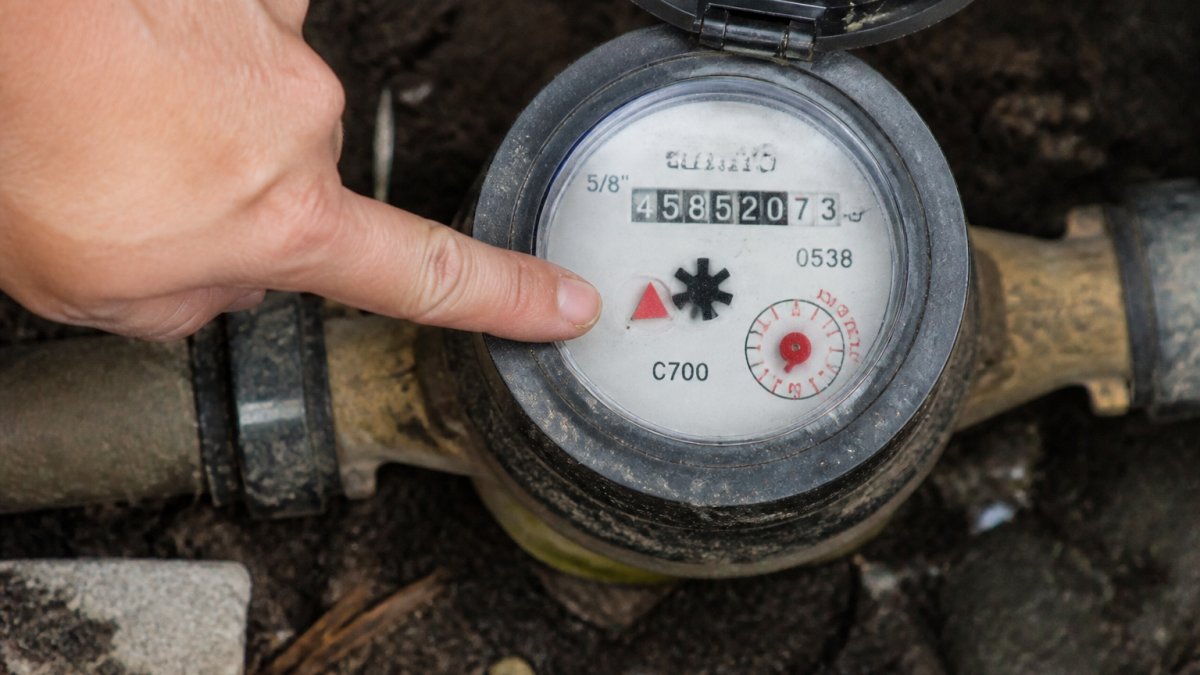
- Meters with a leak indicator have a small triangle, star, or gear that spins whenever any water moves through the meter, even a trickle.
Read the leak indicator first
The leak indicator is the fastest check. With every fixture, appliance, and spigot off, watch it for two to three minutes.
A slow, intermittent spin suggests a small leak like a running toilet; a steady spin points to continuous flow, more consistent with a service-line leak.
Use the odometer for a timed test
For a definitive reading, record the odometer number, the large cumulative figure, not the small dials, note the exact time, wait 30 to 60 minutes with no water use, then read it again. Learn how to find hidden pipe leaks using similar detection methods and professional guidance.
- No change: no measurable flow during the test window.
- Small change: a slow leak, often an indoor fixture.
- Large or steady change: significant continuous flow, which raises the probability of a main line or service-line leak.
Run the test twice, once overnight and once during the day. A leak that only appears at certain times may be tied to an irrigation timer, water softener regeneration, or an appliance.
Photograph the meter face before and after the test. The timestamp on your phone plus the meter reading gives you a documented record you can share with your utility or plumber.
What each result means
| Meter behavior | Likely meaning | Next step |
|---|---|---|
| Indicator still, odometer unchanged | No flow detected during test | Recheck at a different time; rule out intermittent causes |
| Indicator spins slowly, small odometer change | Slow leak, often indoor | Check toilets, appliances, and irrigation |
| Indicator spins steadily, large odometer change | Continuous flow | Perform the isolation test to separate indoor from service-line leak |
| Digital display shows a leak icon | Meter has flagged continuous flow | Confirm with the odometer test, then isolate |
Limits of the meter test
The meter confirms water is moving, not where it’s going, and it can’t detect a leak on the utility side of the meter since that water never passes through it. If the meter shows no flow but you still see wet ground, low pressure, or a rising bill, contact your utility.
Underground Water Leak Signs in Your Yard
Main water line leaks often announce themselves through yard changes as the ground around the leak becomes saturated.
Wet spots and standing water
Look for unusually wet areas, especially in dry weather, a wet patch appearing without rain or watering is a strong indicator.
Standing water pooling in one spot suggests water accumulating underground with nowhere to go but up through the soil.
Check your yard after several days without rain or sprinkler use. Any wet areas that persist are suspicious.
Unusually green or fast-growing grass
Grass directly above a leaking main water line grows faster and greener than surrounding grass, fed by the constant water supply.
You’ll notice a distinct stripe or patch of lush green against normal grass, easy to spot, especially in summer.
If the pattern appears suddenly and stays in one location, investigate further.
Sinkholes and soft ground
Escaping water erodes soil under your yard, creating voids that eventually collapse into sinkholes.
Soft or spongy ground is an early warning, walk your yard and feel for areas that give way underfoot.
Small sinkholes can expand quickly. Don’t ignore them, as they pose a safety hazard and indicate serious water loss.
Step-by-Step Isolation Test
Once the meter confirms water is moving, the isolation test tells you whether the leak is inside your home or in the service line between the meter and the house, determining who you call and what it may cost.
Know your two shutoff valves
There are two valves that matter for this test:
- The house-side main shutoff is inside the home, usually near where the service line enters, a basement wall, crawlspace, utility closet, or garage. It controls all water entering the house.
- The meter-side valve is at or near the meter, often in the meter pit or a curb box. Some utilities control this valve and ask homeowners not to operate it.
Do not force a stiff or corroded valve. Older gate valves can break in the closed position, leaving you without water and facing an emergency repair. If a valve will not turn by hand with reasonable pressure, stop and call a plumber.
Step 1: Shut off every water-using fixture
Turn off faucets, shower valves, and outdoor spigots. Shut off supply valves to the washing machine, dishwasher, ice maker, and water softener. Set the irrigation controller to off, not just rain delay. Confirm no toilet is running.
Step 2: Confirm the meter is still moving
With everything off, watch the leak indicator or record the odometer. If the meter is still, there’s no active flow and the test can’t proceed, repeat later. If it’s moving, continue.
Step 3: Close the house-side main shutoff
Turn the house-side valve clockwise until it stops, isolating the home’s plumbing from the service line. Watch the meter again for two to three minutes.
- Meter stops moving: the leak is inside the home, downstream of the house-side valve. Proceed to Step 4.
- Meter keeps moving: the leak is in the service line between the meter and the house-side valve, the main water line. Proceed to Step 5.
Step 4: Isolate indoor fixtures
If the meter stopped when you closed the house-side valve, reopen it and turn off fixture supply valves one at a time, toilets first, then sinks, then appliances, checking the meter after each. When it stops moving, you’ve found the leaking fixture or branch.
Step 5: Confirm a service-line leak
If the meter kept moving with the house-side valve closed, the leak is in the service line. Reopen the valve so the home has water, then walk the pipe route between the meter and house, looking for the wettest ground, greenest grass, or soft soil.
A moving meter with the house-side valve closed is the clearest homeowner-level evidence of a main water line leak. Photograph the meter, note the time, and call a plumber or your utility before digging.
Step 6: Interpret and act
The isolation test gives a clear answer but doesn’t locate the break precisely. Professionals use acoustic listening devices, tracer gas, or video inspection to pinpoint it without exploratory digging. If the leak is on the utility side of the meter, your utility may handle it; if on the house side, you’re typically responsible.
What to Do When a Main Water Line Is Leaking
A confirmed main water line leak requires professional attention. This is not a DIY repair.
Safety and DIY diagnosis limits
You can diagnose a leak using the methods above. You cannot safely repair a main water line yourself.
Main water lines are buried deep and connected to municipal infrastructure, digging risks hitting gas, electric, or sewer lines.
Stop using water once you’ve confirmed a main water line leak. Continued use increases water damage and your bill.
Responsibility and ownership by location
Responsibility for the main water line varies by location.
Check with your local water utility to confirm responsibility boundaries.
If the utility owns the line, contact them. They may repair it at no charge.
Document the leak with photos, meter readings, and dates, and keep all utility communication in writing.
False Positives and Alternative Causes
Not every sign of water loss means a main water line leak.
A running toilet wastes enormous amounts of water.
Washing machine leaks create wet areas and bill increases.
Water softeners regenerate regularly, using significant water.
Ask yourself: Did the problem start after a freeze, heavy rain, or yard work?
Book Your Professional Leak Inspection
Diagnosing a main water line leak yourself is possible. Fixing it requires a professional.
CW Plumbing uses advanced leak detection equipment to pinpoint breaks without unnecessary digging.
You get peace of mind that the job is done correctly.
Contact CW Plumbing today to schedule a professional leak inspection. Our experienced team is ready to solve your main water line problem quickly and reliably.
Frequently Asked Questions
How do you tell if your water meter is leaking or just running?
Turn off all water fixtures inside and outside your home, then watch your water meter for 15 minutes without using any water. If the meter dial or leak indicator continues to move, water is flowing somewhere, likely through a main water line leak or an active fixture like a running toilet. A stationary meter means no water loss. Check your meter type first: some have a small red or blue triangle that spins even with tiny leaks, while others show movement on the main dial.
What are the signs of a main water line leak?
Watch for sudden spikes in your water bill, low or fluctuating water pressure throughout your home, wet or muddy patches in your yard during dry weather, unusually green grass in one area, sinkholes or soft ground, water discoloration (rust or dirt in tap water), and standing water with no obvious source. A main water line leak often shows multiple signs at once. The main water service line runs from the meter to your house, so leaks typically appear between those two points.
What should I do if I confirm a main water line leak?
First, locate your main shutoff valve (usually near the meter or where the water service line enters your home) and know how to turn it off in an emergency. Document the leak location and take photos. Contact a licensed plumber immediately, main water line leaks require professional repair and can cause property damage if left untreated. Temporary repairs are not reliable. Check your homeowner’s insurance and confirm responsibility: you typically own the line from the meter to your house, while the utility company owns the line from the main to the meter. Your plumber can advise on next steps.
How much does it cost to fix a main water line leak?
Repair costs depend on the leak’s location, depth, pipe material, and whether excavation is needed. Contact CW Plumbing for a professional assessment and quote. We can diagnose the exact problem and provide transparent pricing for your situation. Emergency repairs may have different rates than standard service calls.
A main water line leak doesn’t have to become a costly disaster. Early detection saves money and prevents property damage. CW Plumbing has the expertise and equipment to find and fix leaks fast. Get started with CW Plumbing and stop water loss before it gets worse.
